The fastest way to write a year-end review is to see a good one first. This page starts with two full examples: a sample year-end self-review written by an employee, and a sample year-end review of the same person written by their manager. Then come 20 end-of-year self-assessment examples, vague and strong side by side, and the 30 questions to answer before you write your own. Swap in your work and your numbers, and you have a draft in an evening.
Because nobody remembers their year. Ask most people in December what they did in March, and they'll check their calendar. That's a problem when your self-evaluation asks for your biggest accomplishments, your raise depends on them, and your manager is relying on you to supply the details.
A year in review fixes that in about an hour. You get a list of results with numbers, a clear view of what drained you, and a short list of what you want next. Those three things feed your self-review, your goals and any conversation about a promotion or a change of role.
What should a year-end review include?
Most year-end review forms, for a self-review or a manager's review, ask for the same five things. If your company has no form, use these as your headings:
Summary: two or three sentences on the year as a whole.
Key results: your three to five biggest contributions, each with what changed because of it.
Goals: which goals you met, which you missed and why, and what you did instead.
Strengths and growth: what you did well, with an example, and one or two areas to work on.
Next year: two or three goals and the support you need.
Year-end review sample: a full self-review example
Here's a complete year-end self-review for Jordan, an operations analyst. It's about 250 words, which is plenty for most forms. Notice how every claim has a number, a date or a name attached.
Summary: This year I focused on cleaning up our month-end process and making our reporting easier to use. The biggest result was a two-day faster close, and I took on vendor management when Sam moved teams in May.
Key results: (1) I cleared the invoice backlog from 140 open items to 12 by June, so month-end close now finishes two days earlier. (2) I built one shared report sheet to replace four separate ones; it saves the team about 3 hours a week. (3) I led the vendor review and cut costs 11% ($18k a year) with no drop in service.
Goals: I met two of my three goals (the backlog and the shared report). The dashboard project was paused in July when priorities moved to invoices; I moved over within a week.
Strengths: Fixing broken processes, and explaining numbers to people who don't live in spreadsheets. Two department heads now ask me for the monthly figures directly.
Where I want to grow: Presenting to leadership. I presented once this year and want to do it every quarter.
Next year: Restart the dashboard by March, cut close by one more day, and present our results to leadership each quarter. I'd like your help getting a slot on the quarterly agenda.
Sample year-end performance review from a manager
And here's the same year from Jordan's manager. A manager's review covers the same ground, but it adds a rating, the impact on the team and a clear next step. It's specific, it's fair and nothing in it will surprise Jordan.
Overall summary: Jordan had a strong year and is rated Exceeds on quality of work and problem solving, and Meets overall. Jordan turned our month-end process from our biggest pain point into one of our most reliable.
Key results: Cleared the invoice backlog (140 to 12 open items by June), which shortened close by two days. Built the shared report that the team now uses every week. Led the vendor review that saved $18k a year.
Strengths: Jordan finds the cause of a problem rather than working around it, and brings a fix, not just the issue. When Sam moved teams in May, Jordan took on vendor management with no missed renewals.
Areas to develop: Sharing work earlier. Two reports this year arrived finished but late for review; a rough draft at the halfway point would let others help sooner. And building confidence presenting to senior audiences.
Goals for next year: Restart and deliver the dashboard by the end of Q2. Present the monthly results at two leadership meetings by June. Mentor the new analyst through their first close.
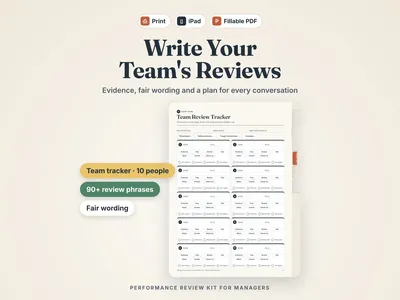
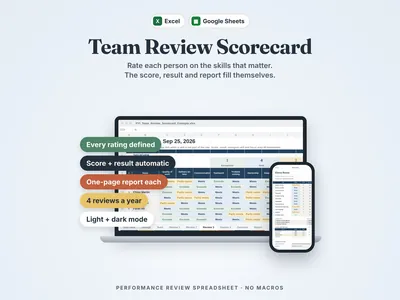
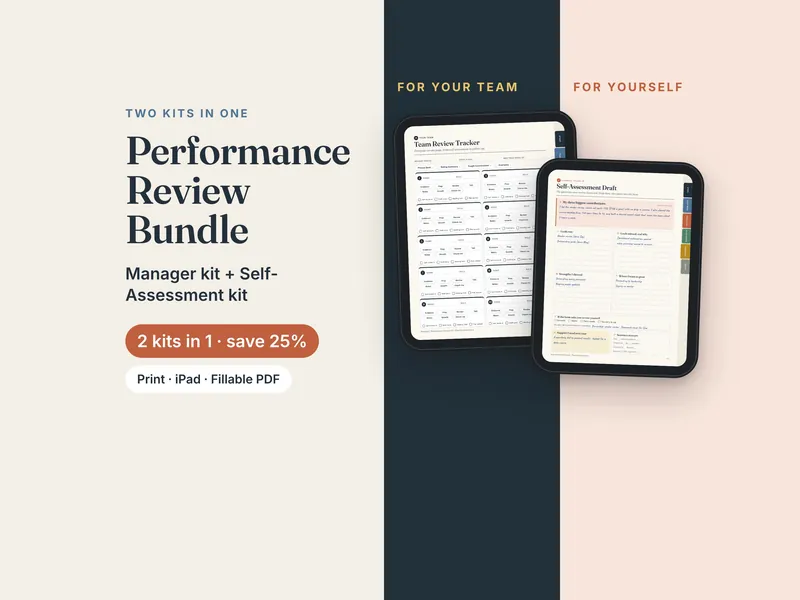
Managers: if your company doesn't give you a staff annual review template, use the same five parts for every person on your team: a summary, results, strengths, growth areas and goals, each with an example. The Review Writing Worksheet in our Manager's Performance Review Kit is laid out in exactly that order, with every rating level defined.
Before you write your own: rebuild your year in 20 minutes
Don't answer the questions from memory. Gather the evidence first:
Open your calendar and scroll month by month. Write one line per month: the main thing you worked on.
Search your sent email and chat for "thank you", "great job", "launched" and "done". Copy any quotes worth keeping.
Open last year's goals, or your last review, and mark each goal done, partly done or dropped.
Pull the numbers your team is measured on: the dashboard, the monthly report or the targets.
If you kept a brag document or a weekly log, start there. It does most of this for you.
With twelve lines in front of you, the questions below take about an hour. Answer in short notes, not essays. You'll polish the best answers later.
30 year-end review questions to answer first
The examples above came from answering questions like these. Pick the ones that make you stop and think. The first and last groups matter most if you have a review coming.
What you delivered
What are the three things I'm proudest of this year?
What did I finish that wouldn't have happened without me?
What numbers moved because of my work: time, money, errors, customers, sales?
Which problem did I solve that nobody asked me to?
What did I make easier, faster or cheaper for someone else?
Who thanked me, and for what? (Find the exact words.)
Which goals did I meet, and which did I miss? Why?
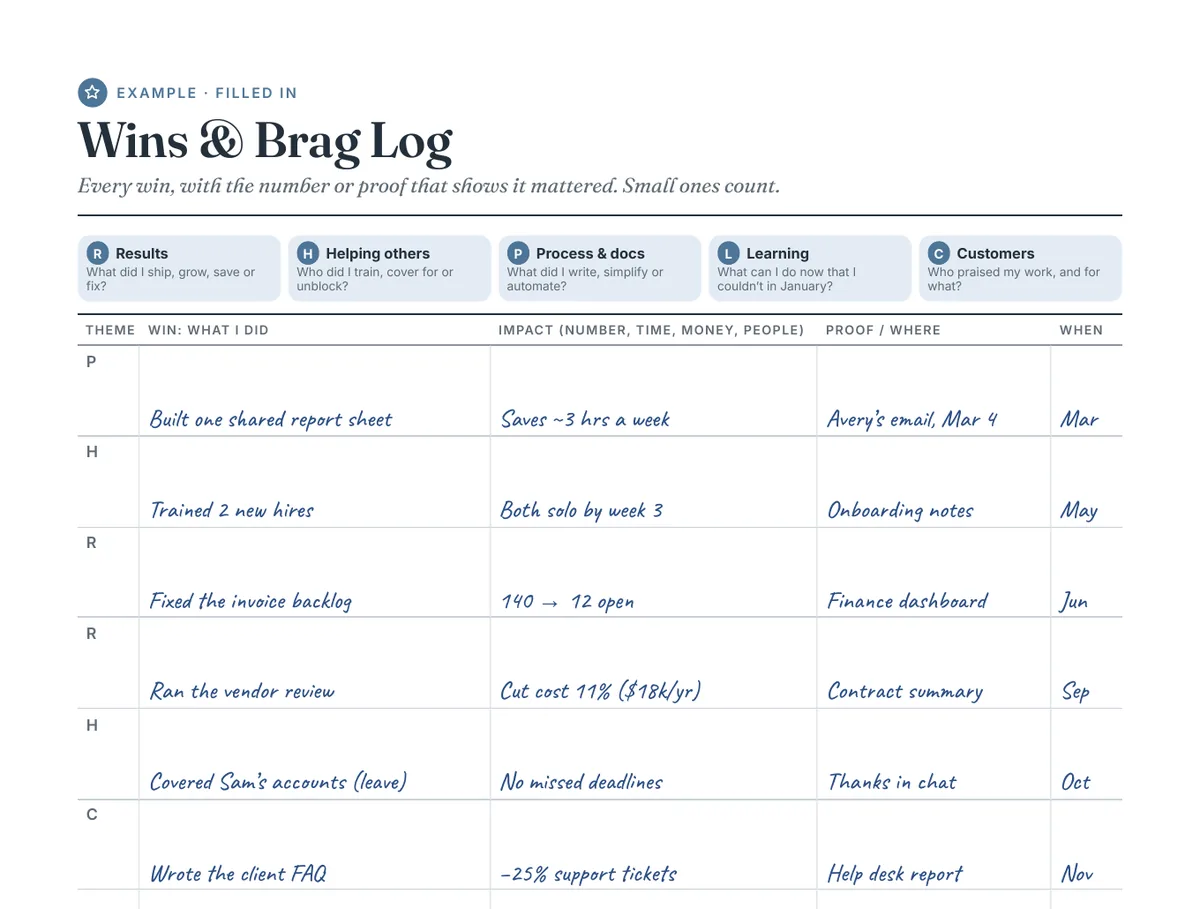
The Wins & Brag Log from the Year-End Work Review Kit: each win with a number and where the proof lives.
What you learned
What can I do now that I couldn't do in January?
What was the hardest thing I worked on, and what did it teach me?
What feedback did I hear more than once?
What mistake taught me the most, and what do I do differently now?
Who taught me the most this year?
What did I learn about how this company really makes decisions?
How you worked
When did I do my best work? What made those weeks different?
Roughly where did my time go: deep work, meetings, email, admin, helping others, firefighting?
Which work gave me energy, and which drained me?
Which meetings, tools or habits should I drop?
What did I say yes to that I should have said no to?
How was my workload across the year? When was it too much?
People and relationships
Who did I help most this year: trained, covered for, unblocked?
Which working relationship got better, and which needs work?
Who are the people I'd want on my next project?
Did my manager know what I was working on? How do I know?
What you want next
What do I want to be known for at work by the end of next year?
What's one skill I'll build on purpose?
What work do I want more of, and less of?
Is there a promotion, raise, project or role I want to ask for?
What support do I need from my manager to get there?
What will I stop doing?
What's the first step, and what date will I take it?
End-of-year self-assessment examples: vague vs strong
The difference between a weak and a strong self-assessment is almost always the same: a strong answer names what you did, what changed, and a number or a person who noticed. Here are 20 end-of-year self-assessment examples grouped by situation. Swap in your own work and numbers.
If you're an individual contributor
Vague: "I worked hard on the invoice backlog." Strong: "I cleared the invoice backlog from 140 open items to 12 by June, so month-end close finished two days earlier."
Vague: "I'm good with spreadsheets." Strong: "I built one shared report sheet that replaced four separate ones. It saves the team about 3 hours a week."
Vague: "I helped with the vendor review." Strong: "I led the vendor review and cut costs 11% ($18k a year) with no drop in service."
Vague: "I learned a lot this year." Strong: "In January I couldn't write a SQL query. Now I pull my own data for the monthly report instead of waiting two days for the data team."
Vague: "I want to grow." Strong: "Next year I want to present our results to leadership myself, at least once a quarter."
If you manage people
Vague: "The team did well." Strong: "We closed 96% of tickets within our 24-hour target, up from 81%, while handling 20% more volume with the same headcount."
Vague: "I supported my team's development." Strong: "Two people on my team took on new responsibilities: Priya now owns vendor renewals and Sam runs onboarding."
Vague: "I improved communication." Strong: "I replaced the daily status meeting with a written update. That gave each person back about 2 hours a week."
Vague: "I had a tough year with hiring." Strong: "I hired three people in a tight market. All three passed probation and were working solo within a month."
Vague: "I want to be a better leader." Strong: "Next year I'll hold every 1:1 on schedule and ask my team for feedback on me twice, in March and September."
If you lead projects
Vague: "I managed several projects." Strong: "I delivered four of five projects on time. The fifth slipped three weeks when the vendor changed, and I flagged it to the sponsor the same day."
Vague: "I kept stakeholders updated." Strong: "I started a one-page weekly status report. Escalations from the sponsor dropped from most weeks to two all year."
Vague: "The launch went well." Strong: "The new portal launched on the planned date and cut support tickets 25% in its first month."
Vague: "I'm organized." Strong: "I built the team's project tracker. Everyone now updates one Gantt chart instead of three spreadsheets."
Vague: "I want bigger projects." Strong: "Next year I'd like to lead a cross-team project with a budget, like the Q2 system migration."
If it was a hard year, or you're thinking of moving on
Vague: "It was a difficult year." Strong: "We lost two people in March. I covered both accounts for four months and we missed no deadlines."
Vague: "My goals changed." Strong: "The dashboard project was paused in July when priorities moved to invoices. I moved over within a week and the backlog was cleared by September."
Vague: "I'm not sure this is the right role." Strong: "The work that gave me energy was training and process design. I'd like more of it, here or in my next role."
Vague: "I didn't get to do much new." Strong: "I kept the core service running with no outages while learning the new billing system, which I now support for the team."
Vague: "I need a change." Strong: "By March I want either a clear path to senior analyst here or three conversations with teams that do more process work."
Notice that none of the strong answers use big adjectives like "excellent" or "passionate". They don't need to. The numbers and names do the work. If you can't find a number, ask: what would have happened if I hadn't done this?
How do you look back at your energy and workload?
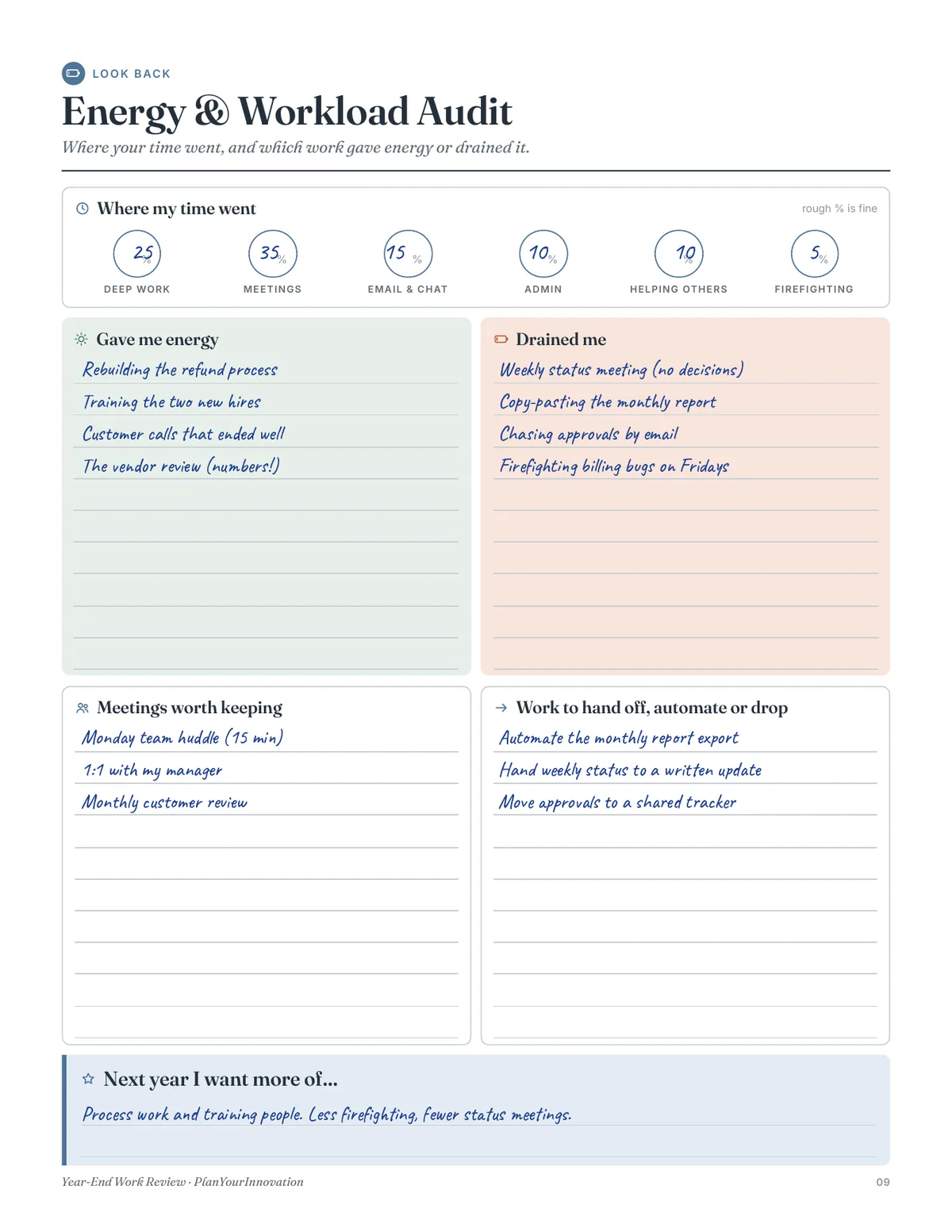
Results are half the picture. The other half is how you got them. Draw a quick estimate of where your time went, then list what gave you energy and what drained you. You don't need exact percentages. Rough is fine, and the pattern is usually obvious once it's on paper.
Then go through the drained list and mark each item: keep, hand off, automate or drop. Most people find one or two meetings and one weekly chore that cost far more than they return. Those make some of the best goals for next year, because nobody else will fix them for you.
An Energy & Workload Audit: where the time went, and what to keep, hand off or drop next year.
How do you turn your answers into a self-evaluation?
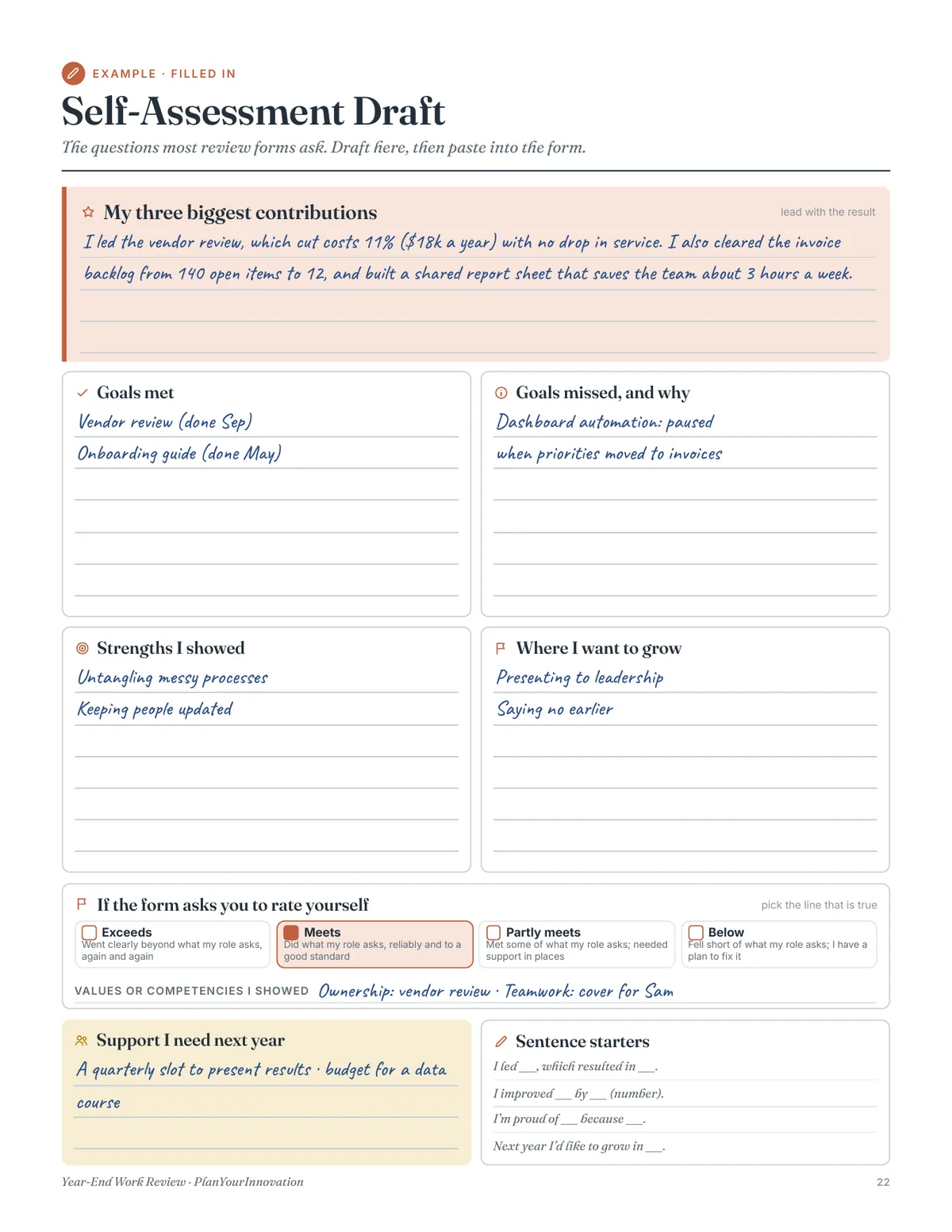
Most review forms ask the same five things: your biggest contributions, goals met, goals missed, strengths and where you want to grow. Your answers map straight onto them:
Biggest contributions: your three strongest answers from "What you delivered", each written as what you did and the result.
Goals met and missed: from the goals question. For a miss, say why in one line and what you did instead.
Strengths: the patterns in your best work and in the feedback you heard more than once.
Where you want to grow: from "What you learned" and "What you want next".
Support you need: from the manager question in "What you want next".
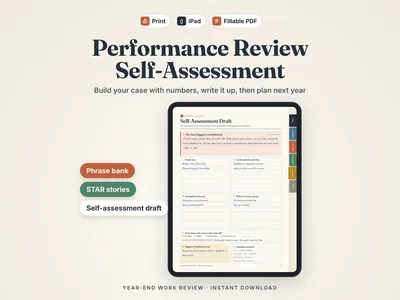
The same answers turned into a Self-Assessment Draft, ready to paste into a review form.
Write each one as one or two sentences that lead with the result. Our guide on how to write a self-evaluation has the full step-by-step and more example phrases.
Most years don't. Projects get canceled, teams change, priorities move in July. A year in review isn't a scorecard on your original plan. It's a record of what you actually did with the year you got.
So write the missed goals honestly and briefly, then write what you did instead. "The dashboard was paused when priorities moved to invoices" followed by the invoice result is a stronger story than pretending the dashboard didn't exist. Covering for a colleague, keeping a service running through a reorg, or learning a system nobody else understood all count. They're just easy to forget because they weren't on the plan.
How do you use your answers to plan next year?
Take your answers from "What you want next" and "How you worked" and pick two or three goals. A good mix is one result goal (a number you want to move), one skill goal and one "stop doing" goal from your energy audit. Write the first step for each with a date in January. Our work goals examples for 2027 show how to make each one specific.
Then make next December easier. The hardest part of a year in review is remembering. Write one line every Friday about what you got done and what changed because of it, and the whole exercise becomes copy and paste. If you want a page for that, my free Self-Review Brag Doc has a weekly wins log, and our guide on how to write a brag document shows what to put in it.
If you'd like pages for this step, the 2027 Goal Planning Kit starts with 2026 in One Page and Where I Stand, then turns your two or three goals into a 12-week plan for each quarter of 2027.
Turn your review into a Q1 plan
A year-end review is only half the job. The other half is making sure next year's goals don't sit in a drawer until next December. The simplest way is to turn your two or three goals into a 12-week plan for the first quarter: for each goal, a few key results you can measure, the weekly actions that move them, and a five-minute score every Friday.
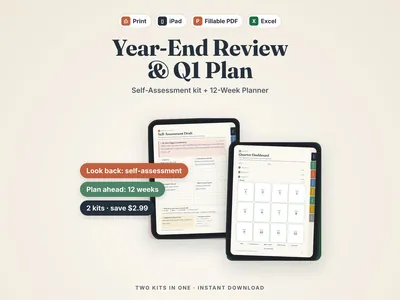
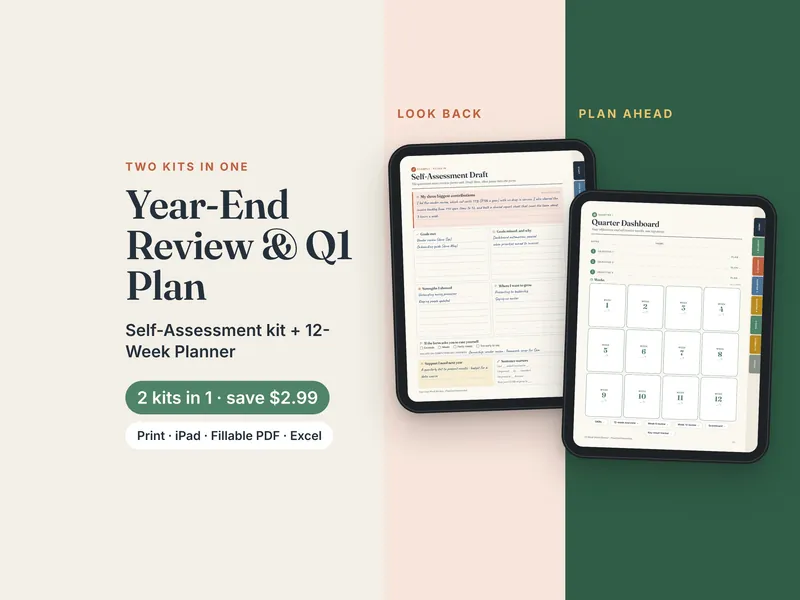
If you'd like that done on paper, the Year-End Review & Q1 Plan puts both halves together: the Year-End Work Review Kit for looking back, and a 12-Week Work Planner with OKRs for the first quarter, with weekly plan and scorecard pages, week 6 and week 12 reviews, and a 12-Week Scorecard spreadsheet for Excel and Google Sheets.
What problems does the Year-End Work Review Kit solve?
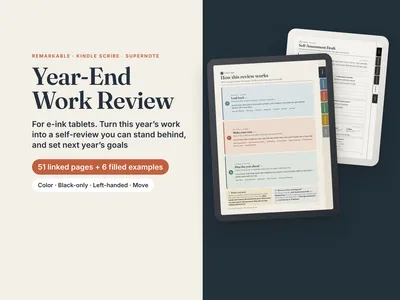
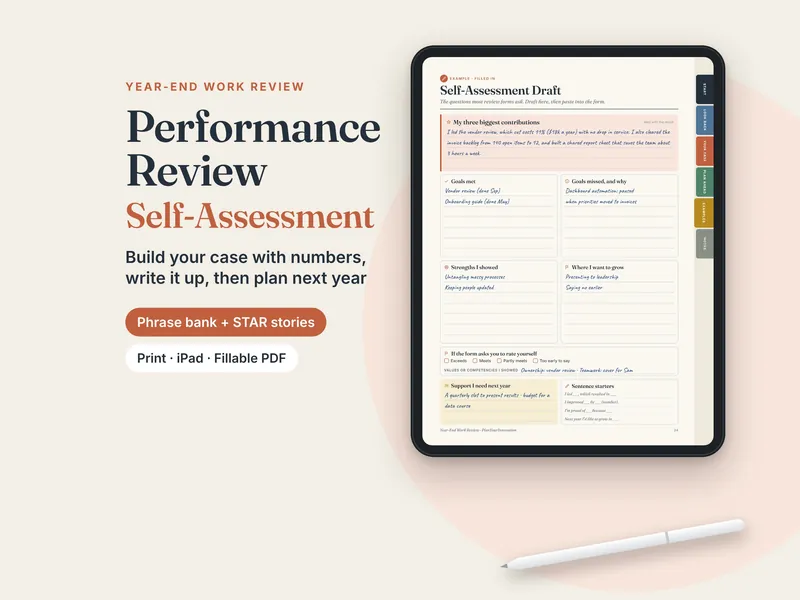
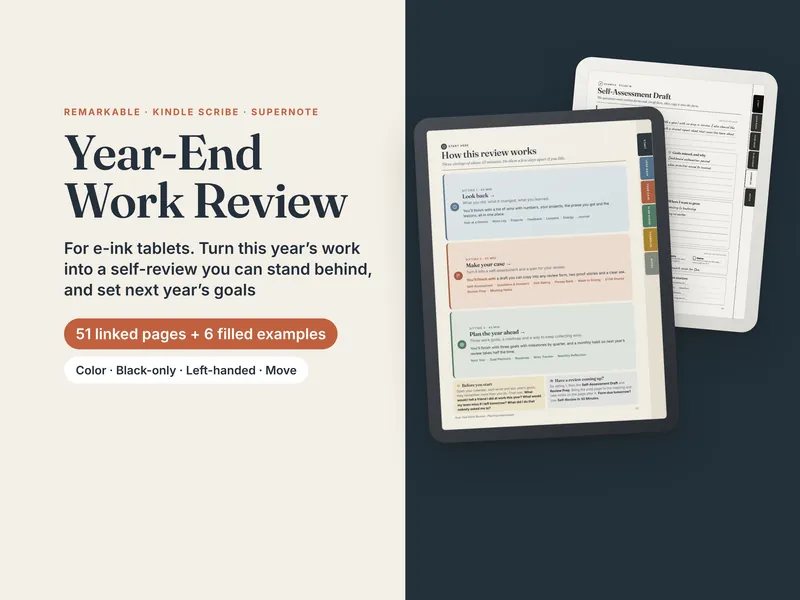
Reading a year-end review sample is the easy part. Writing your own means remembering twelve months of work and turning it into a few strong lines. The Year-End Work Review Kit takes you through it in order:
The problem: you can't remember what you did in March. How it helps: Year at a Glance gives you one line per month, and the Wins & Brag Log and Projects I Delivered pages rebuild your year with the number or proof for each win.
The problem: your self-review sounds vague, like "worked hard on many projects". How it helps: the Self-Assessment Draft has sentence starters and a phrase bank, and the STAR Story Builder turns your best results into short, specific stories.
The problem: you only remember the wins, or only the misses. How it helps: Feedback & Recognition and Lessons & Misses pages give you a fair picture, and the Energy & Workload Audit shows what drained you and what to change.
The problem: the review ends and next year starts with no plan. How it helps: the goal planner for next year has a SMART check, the likely obstacle and how you'll handle it, so your review turns into next year's first steps.
Templates that help
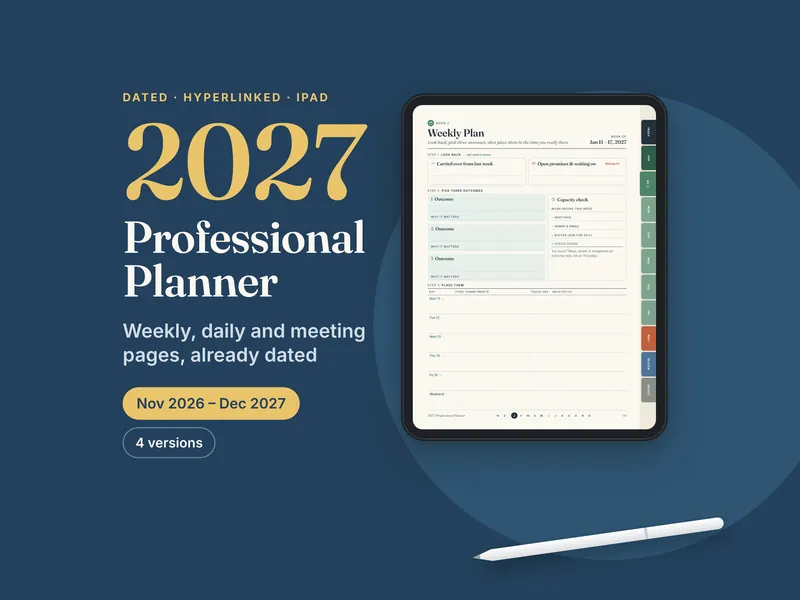
The Year-End Work Review Kit turns these questions into pages: Year at a Glance with one line per month, a Wins & Brag Log, Projects I Delivered, Feedback & Recognition, Lessons & Misses, an Energy & Workload Audit, then a Self-Assessment Draft and a goal planner for next year, with filled-in examples like the ones in this post. The Year-End Review & Q1 Plan adds a 12-week plan for your first quarter, and the 2027 Professional Planner carries your goals into a dated year.
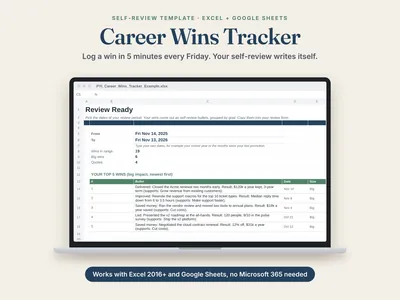
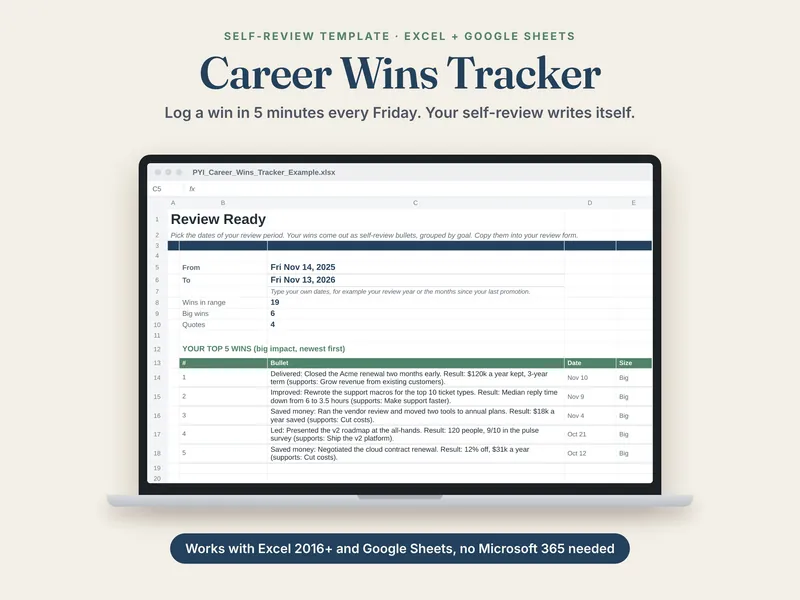
Want next December to be easier? Log one win each Friday in the Career Wins Tracker, a spreadsheet that turns each win into a review statement and a resume bullet. Its Review Ready tab pulls your top wins and quotes when it's time to write.
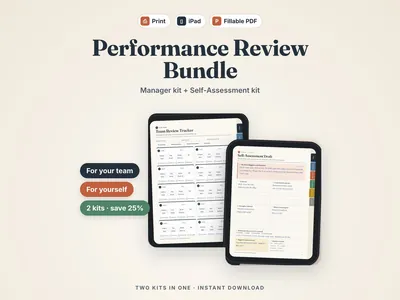
Planning more than your review? The Working Year Bundle puts 23 of our work tools in one download, including this kit and the 2027 Professional Planner, for review season, managing a team, running projects and starting a new job.
About 200 to 400 words, or one page. Three to five results with numbers beat a long list of everything you did. If your form has boxes, two or three sentences per box is enough.
When should I do a year in review?
Early December, or two weeks before your self-evaluation is due. It's easier while the year is still fresh, and before the holiday break.
How long does a year in review take?
About 20 minutes to gather your calendar, email and goals, then about an hour for the questions. Turning the best answers into a self-evaluation takes another hour.
Do I have to answer all 30 questions?
No. Answer the ones that make you stop and think. If you have a review coming, focus on "What you delivered" and "What you want next".
Should I share my answers with my manager?
Share the results, not the whole page: your top contributions, what you learned and what you want next. That's the backbone of a good review conversation.
What if I can't find numbers for my work?
Use time saved, errors avoided, people helped or a quote from someone who noticed. Or ask: what would have happened if I hadn't done this?

 By