12 week year planner and template: plan your work in 12-week cycles
Planning in 12-week cycles treats each quarter like a short year. You pick one to three goals, break them into weekly actions and score yourself every Friday, so you know by week 3, not month 11, whether you're on track. Here's how to plan a 12-week year step by step.
Works on your device, or I'll fix it or refund you in full.
How to plan a 12-week year
The first plan takes about 30 minutes. After that, it's ten minutes on Monday and five on Friday.
Start with the long view. Write where you want your work to be in three years, and a theme for this quarter. Twelve-week goals should move you toward it.
Pick one to three goals. Fewer is better. Write each one as an objective with two or three key results you can count, such as "New hires productive in 10 days, down from 21".
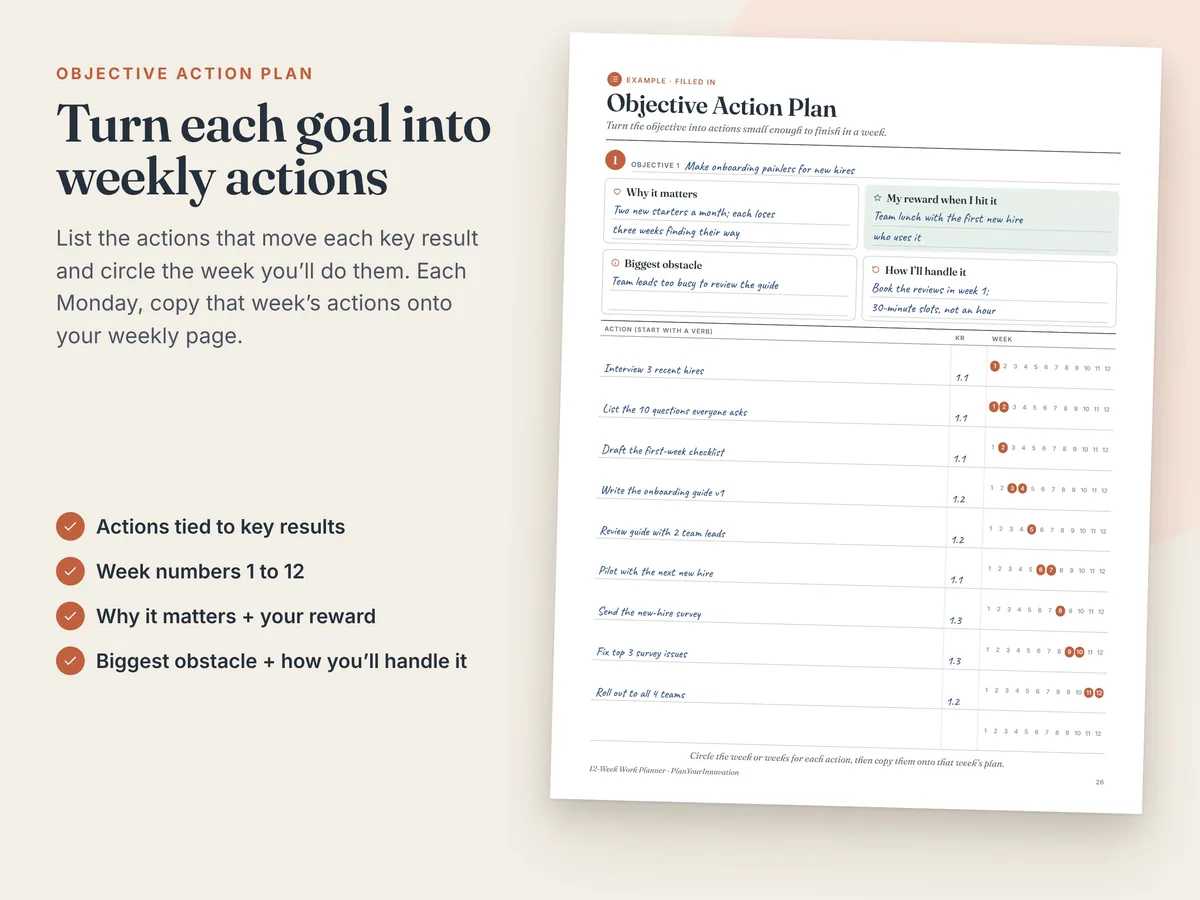
Turn each goal into actions. Write why it matters, your reward, the biggest obstacle and how you'll handle it. Then list the actions and give each one a week number from 1 to 12.
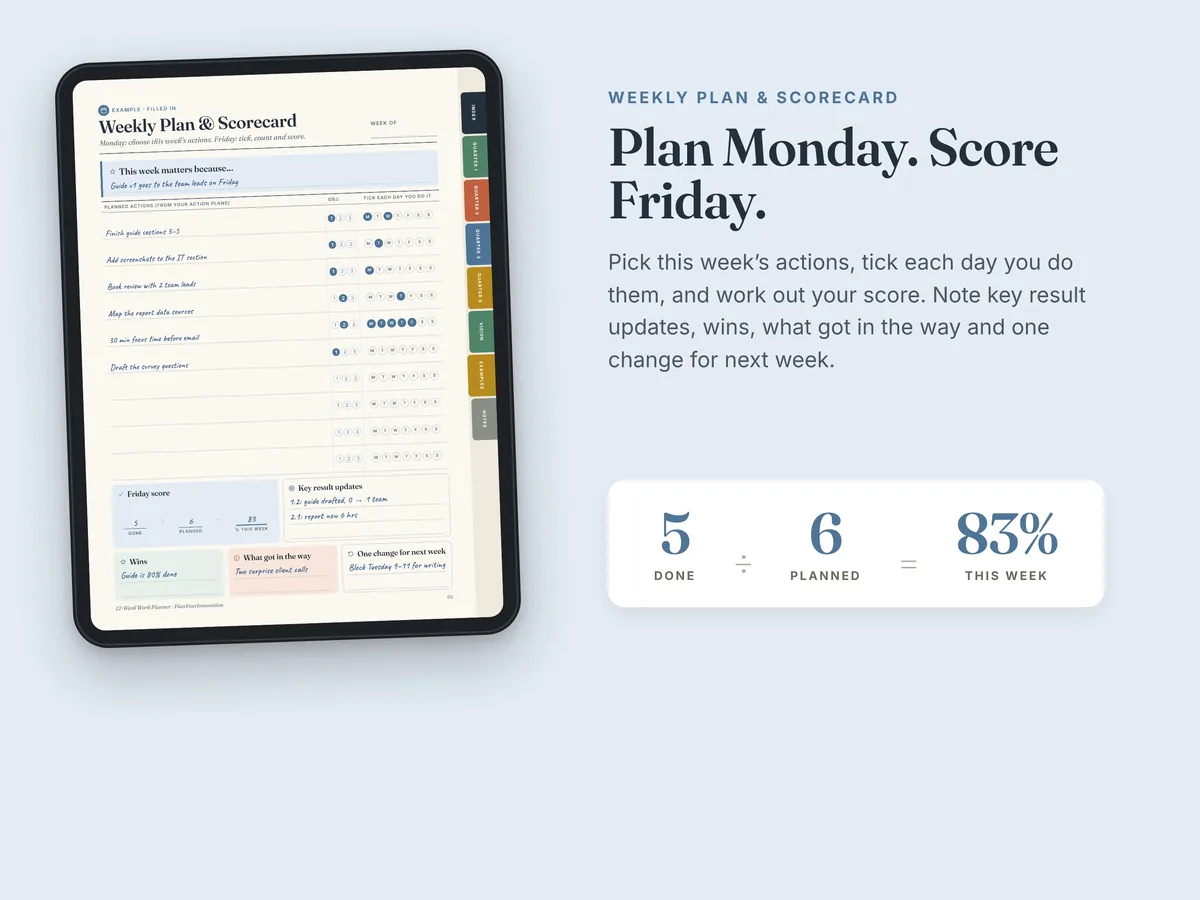
Plan each Monday. Copy this week's actions onto the weekly page. Tick each day you do them.
Score each Friday. Divide actions done by actions planned. Aim for 80%. Note your key result numbers, what went well and one change for next week.
Review at week 6 and week 12. At the halfway point, keep what works and cut what doesn't. At week 12, close the quarter and carry what you learned into the next one.
The action plan: each action gets a week number from 1 to 12.
Why 12 weeks works
A year is too long to feel urgent: in March, December feels far away, and the work slides. Twelve weeks is long enough to finish something real and short enough that every week counts. A weekly score turns the plan into something you can see. A run of 80% weeks beats a perfect plan you stopped checking in week 4.
Plan Monday, score Friday: 5 done out of 6 planned is 83%.
OKRs and the 12-week year
OKRs (objectives and key results) are the goal method many tech companies use: an objective says what you want, and key results say how you'll know you got there. They fit 12-week cycles well, because each key result has a start, a target and a number you can update every Friday. My planner uses OKRs sized for one person instead of a whole company.
A ready-made 12 week planner
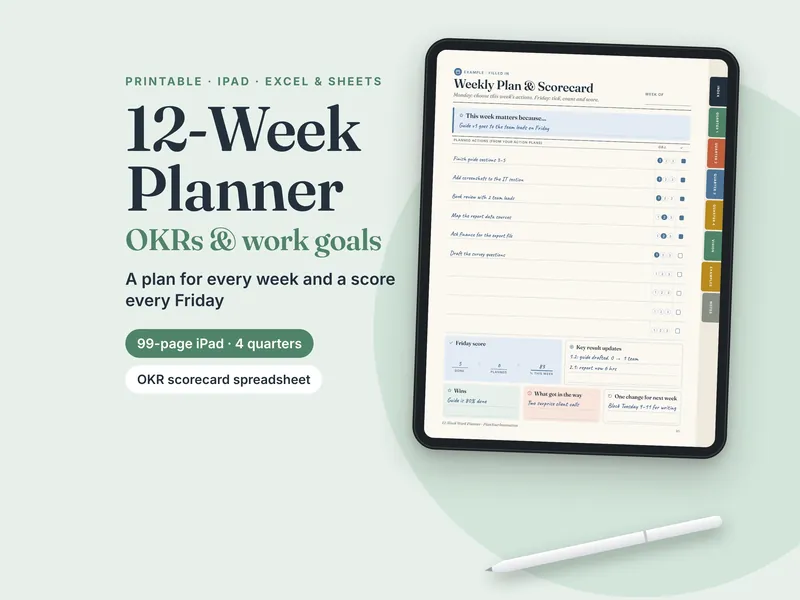
The 12-Week Planner is $7.99 and has everything above in 29 pages: Vision & Focus, Objectives & Key Results, three Objective Action Plans, a 12-Week Overview, 12 numbered Weekly Plan & Scorecard pages, Week 6 and Week 12 Reviews, a Weekly Scoreboard and a Key Result Tracker, with three filled-in examples.
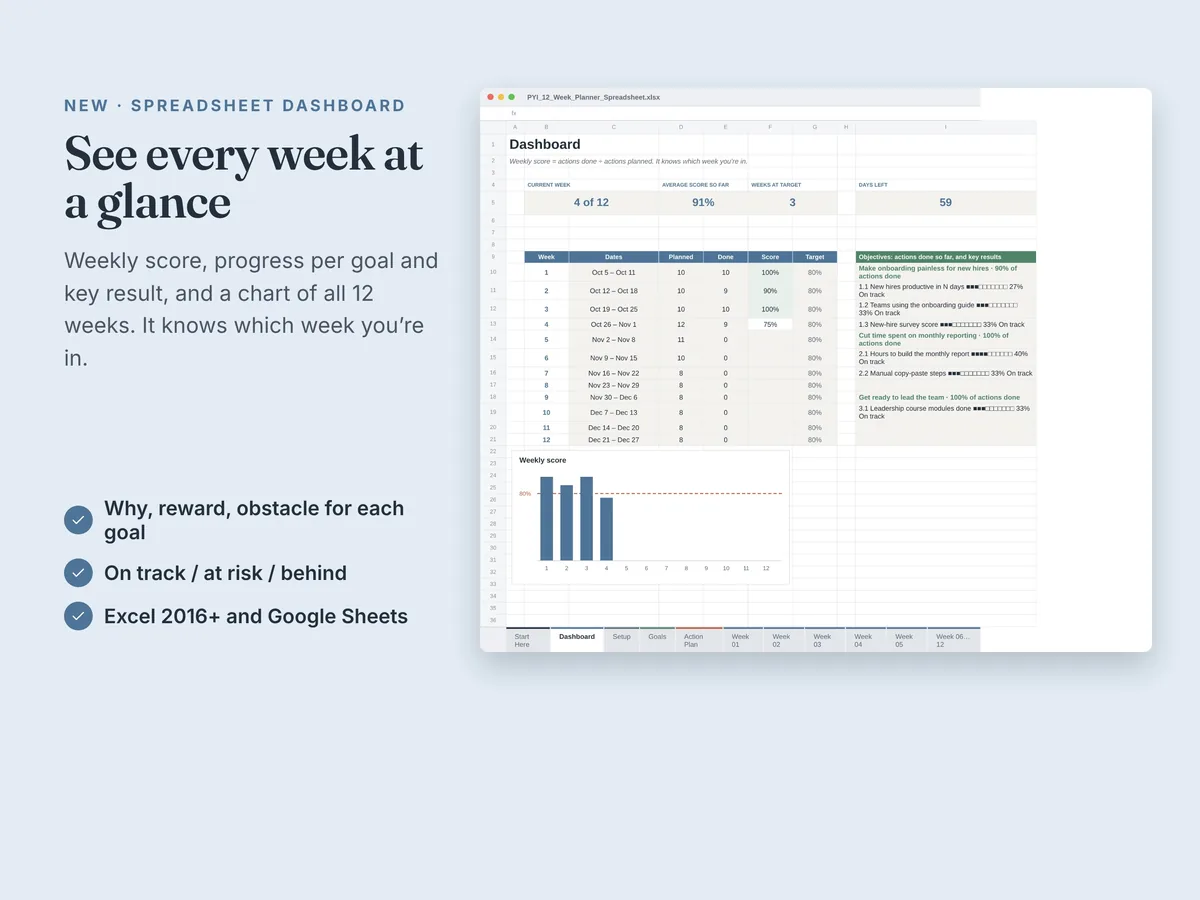
It comes as fillable Letter and A4 PDFs, an A5 file, a 99-page hyperlinked iPad planner with a full set for each of four quarters, and a spreadsheet for Excel and Google Sheets. In the spreadsheet you enter each action once, with how often and which weeks, and all 12 week tabs fill themselves. A dashboard shows your weekly scores and whether each goal is on track, at risk or behind.
The spreadsheet dashboard: every week's score and every goal's status.
Start the new year with a 12-week plan
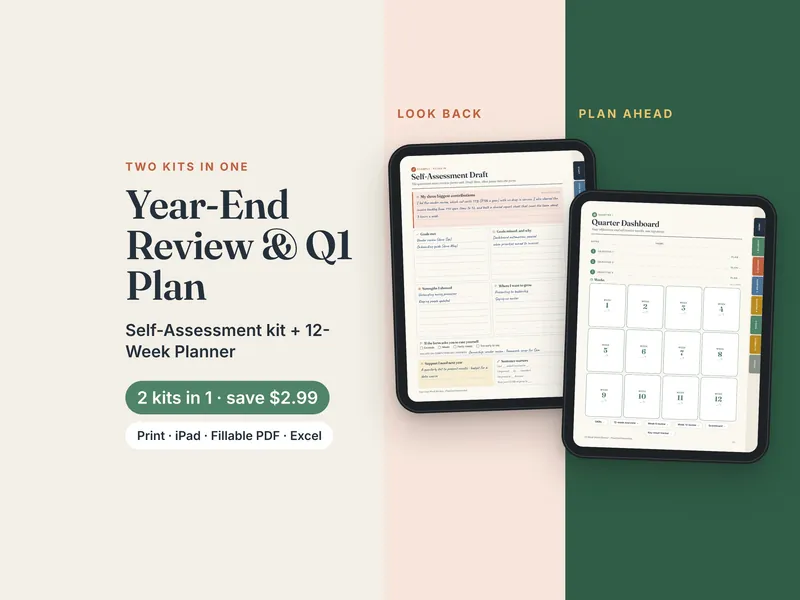
The Year-End Review & Q1 Plan is $12.99 and puts the 12-Week Planner together with the Performance Review Self-Assessment. Write a self-review you can stand behind, then turn next year's goals into your first 12 weeks. The 2027 work goals guide has more on choosing goals.
Planning all four quarters, not just the first? The 2027 Goal Planning Kit has 128 pages: your 2027 goals, then four dated 12-week quarters starting Monday, January 4, each with key results, weekly scores and reviews at weeks 6 and 13, plus a tracker spreadsheet.
Common mistakes in a 12-week plan
Too many goals. Three is the limit for most people in 12 weeks, and one is often better.
Key results you can't count. "Get better at hiring" can't be scored. "Time to hire under 30 days" can.
Actions with no week number. An action without a week tends to drift to week 12. Give each one its week.
Skipping the Friday score. The score is the point. Five minutes on Friday shows you a slipping week while there's still time to fix it.
The 12 Week Year is a book by Brian P. Moran and Michael Lennington. This planner is an independent design based on 12-week planning and OKRs, and isn't affiliated with or endorsed by the authors.
A planner that treats each quarter as a short year: one to three goals, weekly actions, a Friday score and reviews at week 6 and week 12.
How do you score a 12-week week?
Divide the actions you did by the actions you planned. 5 out of 6 is 83%. Aim for 80% or better.
What's the difference between OKRs and the 12 week year?
OKRs are a way to write goals: an objective and key results you can count. A 12-week year is a way to time them. This planner uses both: OKRs for the goals and 12-week cycles to plan and score them.
Can I start a 12-week plan any time?
Yes. The planner is undated, so you can start any Monday, not just in January.
Does it work in Google Sheets?
Yes. The spreadsheet works in Excel 2016 or newer and Google Sheets, with no macros. The PDFs print or work on an iPad.
Is this the official 12 Week Year planner?
No. The 12 Week Year is a book by Brian P. Moran and Michael Lennington. This is an independent planner based on 12-week planning and OKRs.