Most people who don't get a raise never clearly asked for one. They hinted, waited for the review, or hoped their manager would notice. Asking well isn't about being pushy. It's about walking in with a specific number, five pieces of evidence and a calm question. This guide covers when to ask, how much to ask for, how to build your case, a word-for-word script, an email to request the meeting, 20 examples of vague and clear wording, and what to do if the answer is no or not yet.
Timing matters almost as much as the case. Good moments:
Before budgets are set. Many companies plan next year's pay in the fall. Asking in October or November gives your manager time to put you in the budget.
Around your review, but before the meeting where numbers are already decided. Ask your manager when pay decisions are made.
After a clear win, while people still remember it.
When your job has grown, for example after taking on a colleague's work or a new team.
Avoid the week of a reorganization, layoffs or a bad quarter, and avoid asking in passing. Book a proper meeting, so your manager knows it matters.
How much should you ask for?
Ask for one specific number, not a range. Work it out from the market rate for your role, your level and your location: check salary sites, recent job postings that list a range, recruiters and people you trust in similar roles. Then look at what your job has become, not what it was when you were hired.
Have two numbers in mind: the one you'll ask for, and the lowest you'd be happy with. Only say the first. If your company has published pay bands, ask where you sit in the band for your level and what it takes to move up.
How do you build your case?
Your case is five proof points: results with a number, a date or a name attached. Pull them from your last year of work: projects delivered, money saved or earned, time saved, problems fixed, people trained, work you took over. Write each one as what you did and what changed.
Then add one sentence on how your role has grown. "Since May I've managed our vendor relationships, which wasn't part of my role when I was hired." This is often the strongest argument, because it isn't about effort; it's about the job being bigger.
If you've kept a brag document, this takes ten minutes. If you haven't, our guide on how to write a brag document shows how to rebuild a year of wins quickly, and our year-end review examples have 30 questions that help you find them.
How to ask for a raise, step by step
Find out how pay decisions work at your company, and when they're made.
Pick your number from the market range and the size of your role.
Write five proof points and one sentence on how your role has grown.
Email your manager to request a meeting, saying what it's about, so it isn't a surprise.
In the meeting, make the case, say the number, then stop talking. Let them respond.
Agree the next step and a date, then send a short recap email the same day.
What to say: a raise conversation script
Open: "Thanks for making time. I'd like to talk about my pay. I've put some thought into it and I'd value your view."
The case: "Over the last year I've cleared the invoice backlog from 140 items to 12, which cut month-end close by two days. I led the vendor review that saves $18,000 a year. And since May I've managed our vendor relationships, which wasn't part of my role before."
The ask: "Based on that, and on the market range for this role, I'd like to ask for an increase to $82,000 from January."
Then pause. Count to five in your head. The silence feels long; let it be.
Close: "What would you need from me to make that happen? And when can we expect a decision?"
Write your three key points on a card or a page and bring it. It's normal to have notes in a meeting like this, and it keeps you from rambling when you're nervous.
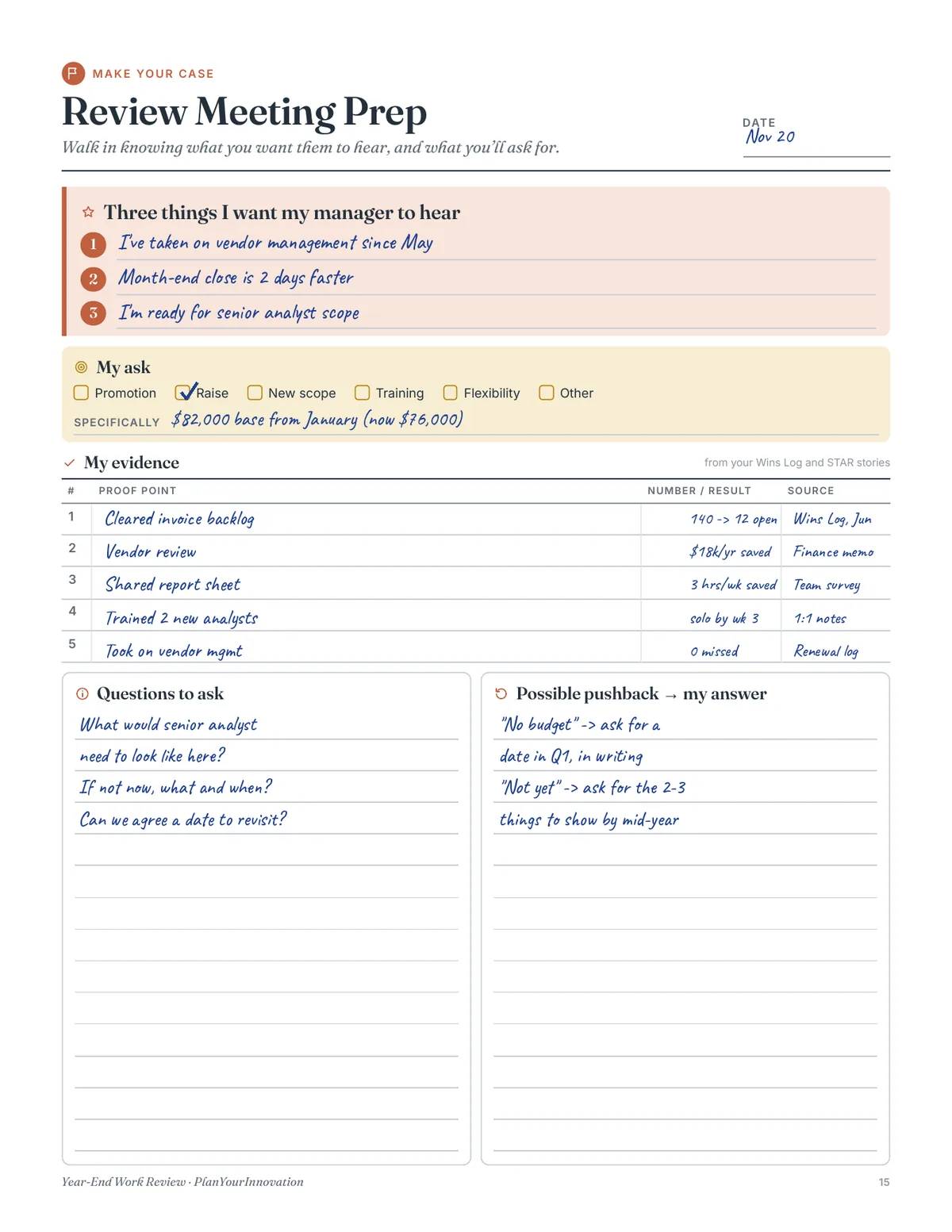
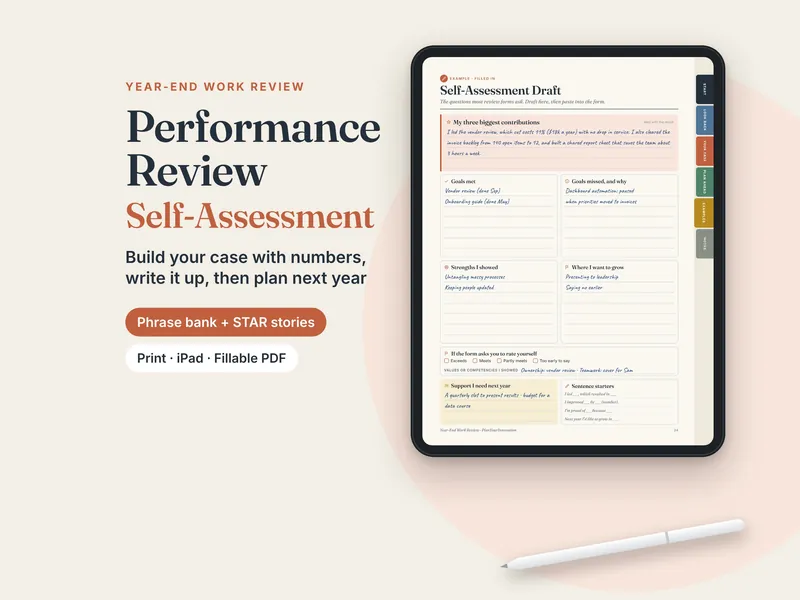
The Review Meeting Prep page from our Year-End Work Review Kit, filled in for a raise conversation.
An email to ask for a raise meeting
Don't make the case by email. Use email to ask for the meeting, so your manager has time to prepare and maybe check the budget first.
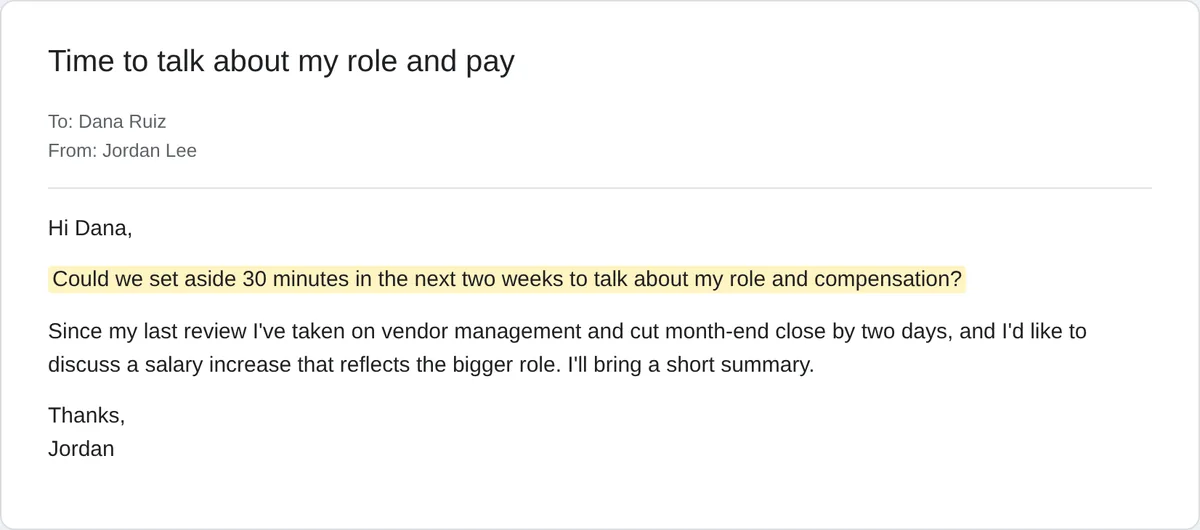
Subject: Time to talk about my role and pay
Hi Dana,
Could we set aside 30 minutes in the next two weeks to talk about my role and compensation? Since my last review I've taken on vendor management and cut month-end close by two days, and I'd like to discuss a salary increase that reflects the bigger role. I'll bring a short summary.
Thanks,
Jordan
Ask for the meeting by email. Make the case in person.
Asking for a raise: 20 examples, vague vs clear
Small wording changes make a big difference. Twenty examples, grouped by the moment in the conversation:
Opening the conversation
Vague: "So, um, I was wondering about money." Clear: "I'd like to talk about my pay today."
Vague: "Sorry to bring this up." Clear: "Thanks for making time for this. It's important to me."
Vague: "Is there any chance of more money?" Clear: "I'd like to discuss a salary increase."
Vague: "Can we chat sometime?" Clear: "Could we set aside 30 minutes next week to talk about my role and compensation?"
Vague: "I feel underpaid." Clear: "I've looked at the market range for this role, and I'd like to talk about where I sit."
Making the case
Vague: "I work really hard." Clear: "I cleared the invoice backlog from 140 items to 12, which cut month-end close by two days."
Vague: "I do a lot more now." Clear: "Since May I've managed our vendor relationships, which wasn't in my role before."
Vague: "I've saved the company money." Clear: "The vendor review I led saves $18,000 a year."
Vague: "People rely on me." Clear: "I trained both new analysts; they were working on their own by week 3."
Vague: "I've been here three years." Clear: "In three years my role has grown from reporting to owning month-end close and vendors."
Making the ask
Vague: "Whatever you think is fair." Clear: "I'd like to ask for $82,000."
Vague: "Somewhere between 5 and 10 percent?" Clear: "I'm asking for an increase to $82,000 from January."
Vague: "I need more because my costs went up." Clear: "Based on my results and the market range for this role, I'm asking for $82,000."
Vague: "Maybe a promotion someday?" Clear: "I'd like to be considered for senior analyst. What would I need to show?"
Vague: "I might have to look elsewhere." Clear: "I want to build my career here, and I'd like my pay to reflect the role I'm doing now."
Answering pushback
Vague: "Oh, OK, no problem." Clear: "I understand. When will budgets be set, and can we revisit then?"
Vague: "But I deserve it." Clear: "What would you need to see from me to make it possible?"
Vague: "Fine, forget it." Clear: "If the salary can't move now, could we look at a bonus, a title change or training budget?"
Vague: "So maybe next year?" Clear: "Can we agree a date in Q1 to review this, and put it in writing?"
Vague: "I'll just keep working hard." Clear: "Could we agree two or three goals that, if I hit them, would support the increase at mid-year?"
What if your manager says no, or not yet?
A no today is often a "not yet" with a reason: no budget, a pay freeze, or a gap your manager wants you to close first. Ask which it is, calmly. Then turn it into a plan: what you'd need to show, by when, and the date you'll talk again. Write it down and send it in your recap email.
If the salary can't move, ask about the things that sometimes can: a one-time bonus, a title change, an earlier review date, training budget, more flexibility or a bigger project. If the answer is still no and the reasons don't add up, that's useful information too. Keep your evidence up to date. It's the same case you'd make to a new employer, and our salary negotiation email examples cover that conversation.
Send a recap email after the meeting
Send it the same day. It shows you're serious and gives you both a record:
"Thanks for talking with me today about my pay. To recap: I asked for an increase to $82,000 from January, based on taking on vendor management, the faster month-end close and the vendor savings. You'll check the budget with Alex and come back to me by December 4. If it isn't possible this cycle, we agreed to set two goals for a review at mid-year. Thanks again for your support."
Common mistakes when asking for a raise
Asking in the hallway instead of a booked meeting.
Giving personal reasons (rent, childcare) instead of results and the market.
Naming a range, which gets you the bottom of it.
Threatening to leave unless you have an offer and would take it.
Comparing yourself to a colleague's pay. Talk about your role and results instead.
Leaving with no next step. Always agree a date.
What problems does the Year-End Work Review Kit solve?
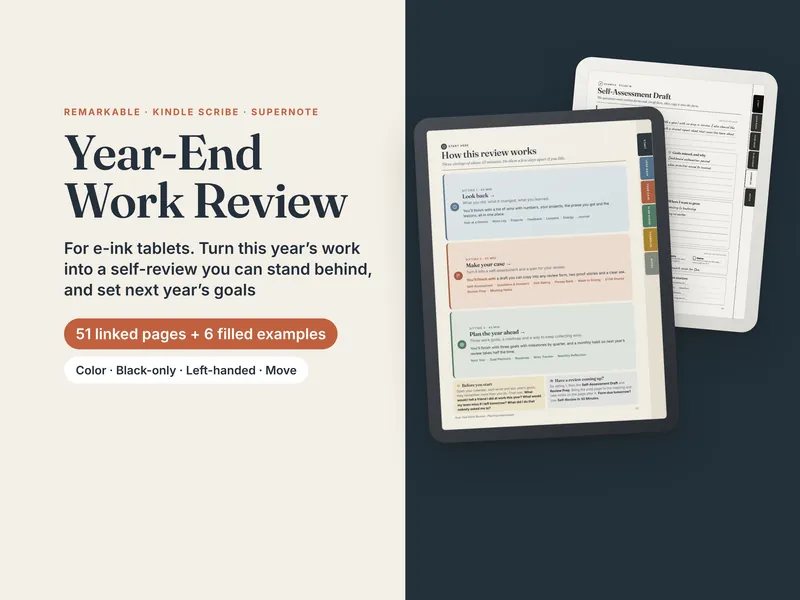
The hardest part of asking for a raise isn't the conversation. It's remembering a year of work well enough to make the case. The Year-End Work Review Kit fixes that in three sittings of about 45 minutes:
The problem: You can't remember what you did in March. How it helps: The Wins & Brag Log and Projects I Delivered pages rebuild your year, with the number or proof for each win.
The problem: Your wins sound vague when you say them out loud. How it helps: The STAR Story Builder turns your two best results into short stories, and the Phrase Bank gives you 24 fill-in-the-blank lines.
The problem: Nerves make you ramble or forget the ask. How it helps: Review Meeting Prep holds your three key points, your ask, five numbered proof points and answers to likely pushback on one page.
The problem: The meeting ends and nothing happens. How it helps: Review Meeting Notes include a recap email script, so the next step and the date are in writing the same day.
Templates that help
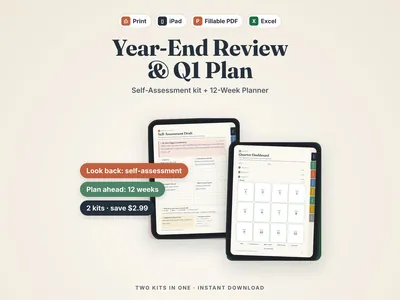
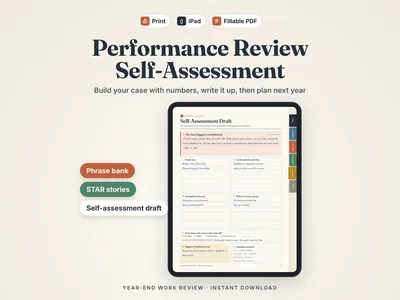
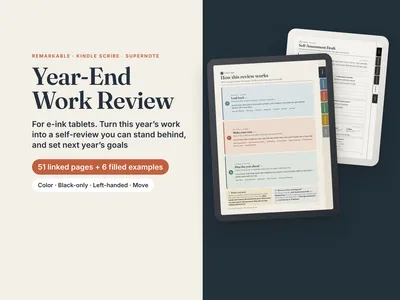
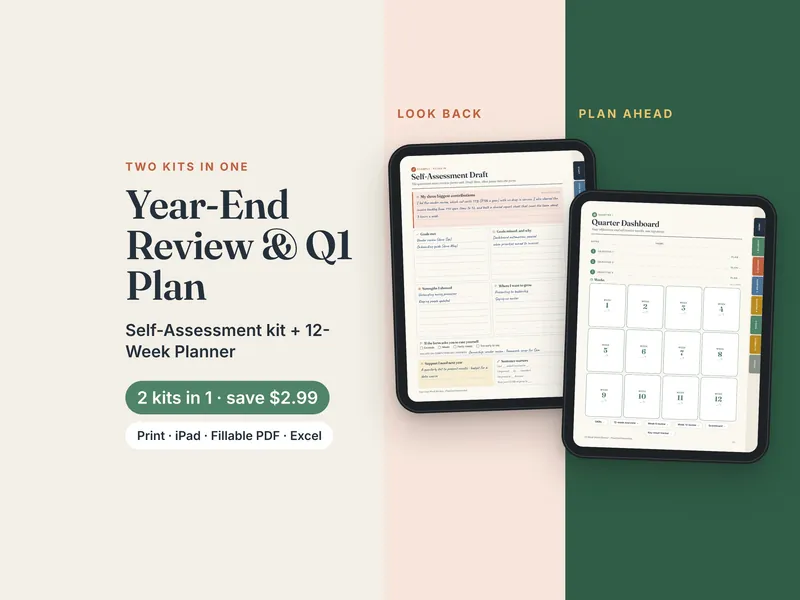
The Year-End Work Review Kit is built for this conversation. A Wins & Brag Log and Projects I Delivered help you gather the evidence, a Self-Assessment Draft and STAR Story Builder turn it into a case, and the Review Meeting Prep page holds your three key points, your ask (promotion, raise, new scope, training or flexibility), five numbered proof points, questions to ask and answers to likely pushback. Review Meeting Notes include a recap email script. The Year-End Review & Q1 Plan adds a 12-week plan for the goals you agree, and the Performance Review Bundle adds the Manager's Review Kit. See all our self-evaluation templates.
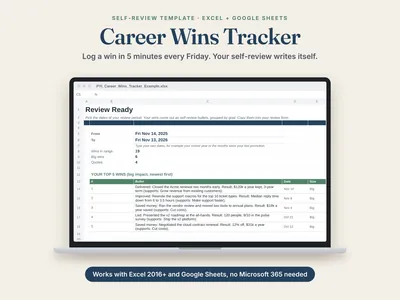
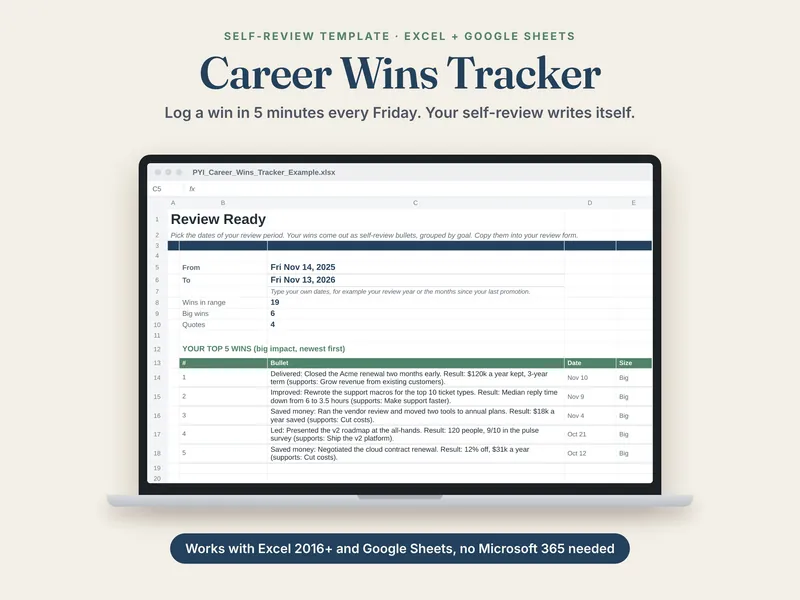
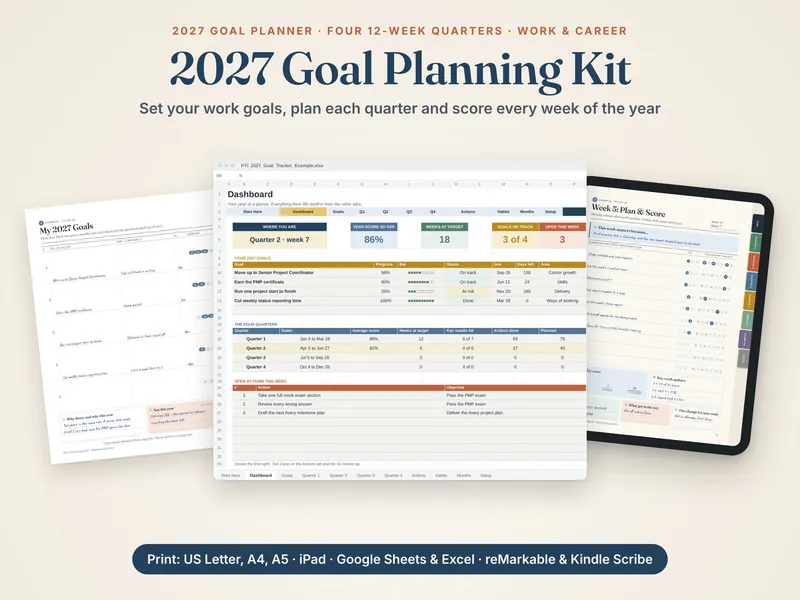
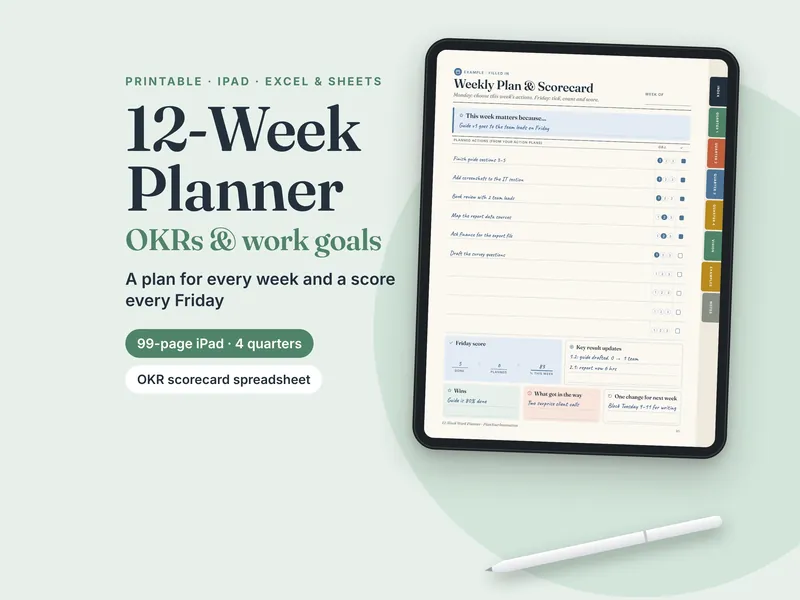
If you'd rather build the case as you go, the Career Wins Tracker spreadsheet logs one win each Friday and turns it into a review statement, so your five pieces of evidence are ready before you book the meeting.
Free download
Build your raise case one Friday at a time
Get my free Self-Review Brag Doc: log one win a week, and your evidence is ready before you book the meeting.
Base the ask on your results and the market rate for the role, not on what you need. A specific number, five proof points and a calm question sound professional, not greedy.
Should I ask for a raise in my performance review?
Ask before it if you can. In many companies pay is decided before the review meeting, so raise it a few weeks earlier and ask when decisions are made.
How much of a raise should I ask for?
One specific number based on the market range for your role, level and location, and on how much your job has grown. Have a lowest acceptable number in mind, but don't say it.
Can I ask for a raise by email?
Ask for the meeting by email, then make the case in person or on video. A conversation lets you answer questions and read the reaction.
What if I've only been in the job a few months?
It's usually better to wait for your first review, unless your role has changed a lot. Use the time to collect evidence, and ask your manager how pay reviews work.

 By