The monthly budget says you're fine. Then rent, the car payment and the credit card all land in the same week, and the paycheck that has to cover them doesn't arrive until Friday. Most budgets are built around the month, but your money arrives by the paycheck: every week, every two weeks or twice a month. A paycheck budget plans each payday on its own: which bills it pays before the next one arrives, what it puts aside and what's left to spend. This guide gives you six steps, a filled-in example for two biweekly paychecks, how to handle each pay schedule and the third paycheck, and 20 vague vs clear examples you can copy.
Want the fill-in version? The Paycheck Budget Spreadsheet ($14.99 on Etsy) is the ready-made template for this guide.
Why monthly budgets break when you're paid every two weeks
A month has bills on fixed dates. A biweekly paycheck lands on a different date every month. In one month your paychecks arrive on the 2nd and the 16th. A few months later it's the 13th and the 27th. If rent is due on the 1st, the paycheck that has to cover it moves around all year.
Three things go wrong. Big bills bunch up in one pay period, so one paycheck comes up short even though the month adds up. Twice a year a third paycheck arrives, and with no plan it disappears into the month. And bills that aren't monthly, like car insurance, annual subscriptions and holiday gifts, arrive as a surprise, because a monthly budget never saw them coming.
How to budget by paycheck: 6 steps
Steps 1 to 3 take about 30 minutes, once. Steps 4 to 6 take about ten minutes each payday.
List every payday for the year. Write the date and your take-home pay, the amount that actually lands in your account after tax and deductions. Mark the months with a third paycheck.
List every bill once, with its due date and how often it repeats. Monthly, every two weeks, quarterly, every six months or once a year. Include the small ones: streaming, apps, the gym.
Give each bill to the paycheck before its due date. A bill belongs to the last paycheck that arrives before it's due. Rent due on the 1st belongs to a paycheck from the second half of the month before.
Spread the big bills. If one paycheck can't cover rent and everything else, split the rent across two paychecks and hold the first half until the due date.
Give savings and sinking funds an amount per paycheck. Divide each goal or yearly bill by the number of paychecks until it's due. A $600 car insurance bill every six months is $46 a paycheck if you're paid every two weeks.
What's left is your spending money until the next payday. Groceries, gas and fun come out of this number. On payday, compare last period's spending with the plan and adjust the next paycheck, not the whole year.
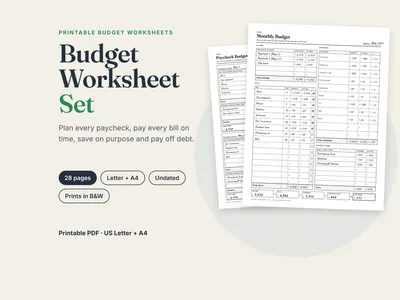
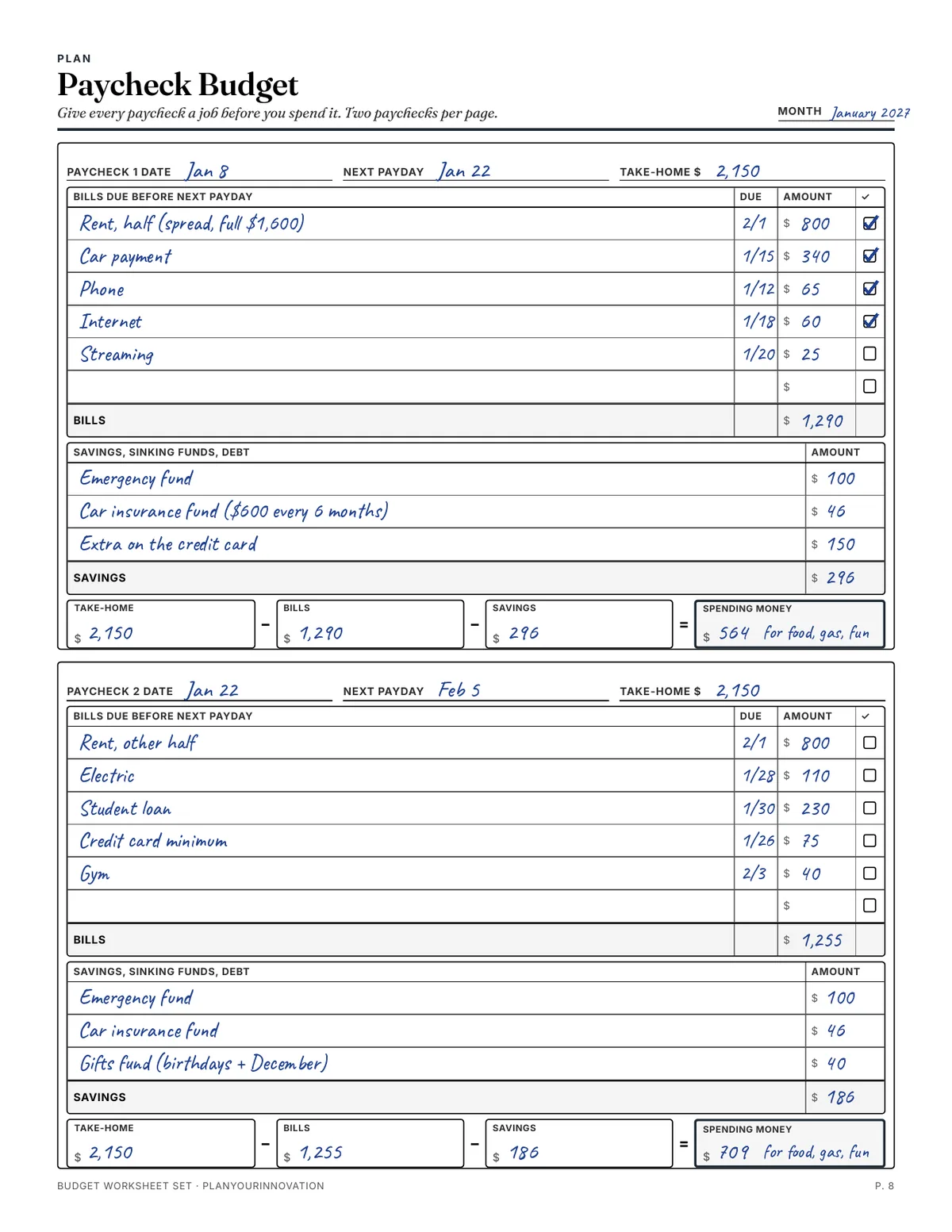
Here's what steps 3 to 6 look like on paper: two January paychecks of $2,150, paid every two weeks, on the Paycheck Budget page:
Two paychecks planned on the Paycheck Budget page from our Budget Worksheet Set. Rent is split across both.
Rent is split across both paychecks, the $600 car insurance bill becomes $46 each payday, and each paycheck shows exactly what's left for food, gas and fun: $564 from the first and $709 from the second. Nothing about the month changed. It just stopped arriving as a surprise.
Which bills go on which paycheck?
Start with the due dates, not the amounts. Write the bills in date order, draw a line at each payday, and every bill above a line belongs to the paycheck before it. Then check each paycheck's total against its take-home pay.
If one paycheck is short and the next has money left over, you have three fixes:
Spread a big bill. Put half of the rent or mortgage on each paycheck and keep the first half in checking, or a separate account, until the due date.
Move a due date. Many card companies, lenders and utilities let you choose your due date. Moving one bill by a week can balance two paychecks.
Pay a bill from the paycheck before. If a bill is due on the 3rd and you're paid on the 5th, it can never wait for that paycheck. Plan it on the one before, every month.
Paycheck budgets for every pay schedule
The six steps stay the same. What changes is how many paychecks you plan and how often the bills move.
Paid every two weeks (biweekly)
26 paychecks a year: two in most months and three in two months.
The paydays move through the month, so check which paycheck covers rent every month, not just once.
Sinking funds: divide a yearly bill by 26, or a six-monthly bill by 13.
Paid twice a month (1st and 15th, or 15th and last day)
24 paychecks a year, always on the same dates, so the bill plan barely changes from month to month.
Bills due early in the month go on the paycheck from the end of the month before.
Sinking funds: divide a yearly bill by 24.
Paid weekly
52 paychecks a year: four in most months and five in four months.
Spread the big bills over several paychecks. A quarter of the rent each week is easier than all of it at once.
A fifth paycheck works like a third biweekly one: give it a job before it lands.
Paid once a month
12 paychecks a year, so a paycheck budget and a monthly budget are the same thing.
The risk is the last week of the month. Split your spending money into weekly amounts so week four isn't empty.
What do you do with a third paycheck?
If you're paid every two weeks, two months a year have three paychecks. Your bills are already covered by the other two, so the third one is extra, but only if you plan it before it lands.
Mark both months on your list of paydays in January. Then decide now: all of it to one goal, like the emergency fund, the highest-rate debt or next year's insurance, or a split, such as half to debt, a quarter to savings and a quarter to spend. A third paycheck with a job builds something. A third paycheck without one disappears.
Paycheck budget examples: 20 vague vs clear
Most budgets fail on how a line is written. A vague line can't be checked, so it can't be kept. These swaps show the difference.
Listing bills and pay
Vague: "Rent." Clear: "Rent $1,600, due the 1st: $800 from each of the two paychecks before it."
Vague: "My salary." Clear: "Take-home $2,150 every other Friday, starting Jan 8."
Vague: "Subscriptions, about $50." Clear: "Streaming $25 (20th), cloud storage $3 (5th), music $11 (14th)."
Vague: "Car insurance sometime in spring." Clear: "Car insurance $600, due Mar 15 and Sep 15."
Vague: "Utilities." Clear: "Electric about $110, due the 28th, higher in July and August."
Giving bills to paychecks
Vague: "Pay the bills when they come." Clear: "Bills due before Jan 22 come out of the Jan 8 paycheck."
Vague: "This paycheck is tight." Clear: "The Jan 8 paycheck is $90 short: move the gym bill to the Jan 22 paycheck."
Vague: "Rent takes most of one check." Clear: "Half the rent from each paycheck, held in checking until the 1st."
Vague: "I'll catch up next payday." Clear: "Ask the card company to move my due date from the 3rd to the 20th."
Vague: "Pay off the card." Clear: "Card minimum $75 on the 26th, plus $150 extra from the first paycheck each month."
Saving on purpose
Vague: "Save what's left at the end." Clear: "$100 to the emergency fund every payday, before any spending."
Vague: "Build an emergency fund." Clear: "Emergency fund to $3,000 by December: $100 from each of 26 paychecks, plus $400 from the third paychecks."
Vague: "Put something aside for Christmas." Clear: "Gifts fund $40 a paycheck: $1,040 by December."
Vague: "The car always needs something." Clear: "Car repairs fund $25 a paycheck."
Vague: "Use the extra paycheck wisely." Clear: "Third paycheck in April: $1,000 to the credit card, the rest to the emergency fund."
Spending and checking in
Vague: "Spend less." Clear: "$564 for food, gas and fun until Jan 22. That's about $40 a day."
Vague: "Groceries, whatever it costs." Clear: "Groceries $300 a paycheck, checked on day 7."
Vague: "I'll look at my budget at some point." Clear: "Ten minutes on payday morning: last period's spending, then the next plan."
Vague: "Something went wrong this month." Clear: "$80 over on eating out: take $40 from the fun money of each of the next two paychecks."
Vague: "Next year I'll be better with money." Clear: "In January, list every payday and every bill. Then a ten-minute check each payday."
Common paycheck budget mistakes
Using gross pay. Budget the take-home number that lands in your account, not your salary.
Planning the month, not the payday. If the month adds up but one paycheck doesn't, you're still short that week.
Forgetting the yearly bills. Insurance, renewals, gifts and car registration are bills too. Give each one an amount per paycheck.
Counting on the third paycheck for bills. Plan your bills on two paychecks a month, or four if you're paid weekly. The extra ones are for goals.
No spending money line. A budget with nothing to spend doesn't survive two weeks. Plan the fun on purpose.
Rebuilding the plan every month. List the bills once with how often they repeat, and let each payday's plan come from that list.
Plan your pay next to your work year
Your paycheck is a work number too. If a raise or a job change is on your list this year, a paycheck budget shows what the difference is worth: $200 more per paycheck is $5,200 a year if you're paid every two weeks. Our guide on how to ask for a raise shows how to make the case with proof, and the 2027 work goals guide has examples for setting a money goal next to your work goals. Comparing offers? Our salary negotiation email examples show what to send.
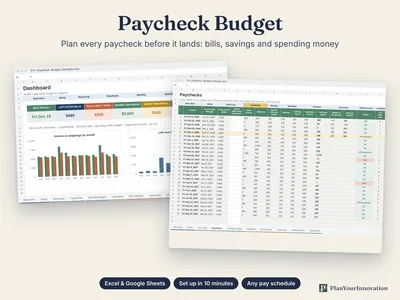
The problem: you don't know which paycheck pays which bill. How it helps: the Paychecks tab lists every payday in your budget year with the bills due before the next one, spread bills, savings, sinking funds and what's left to spend.
The problem: typing the same bills every month. How it helps: enter each bill once on the Recurring tab with how often it repeats, and it fills the months, the bill list and the calendar.
The problem: one paycheck is always short. How it helps: a short paycheck turns red before payday, and Spread over paychecks splits the rent or any big bill for you.
The problem: the third paycheck vanishes. How it helps: third paychecks are flagged, so you can give them a job in January.
The problem: yearly bills arrive as a surprise. How it helps: the Sinking Funds tab shows how much to set aside from each paycheck for up to 15 funds, and how many paychecks are left.
The problem: your pay schedule doesn't fit the template. How it helps: weekly, every two weeks, 1st and 15th, 15th and last day, and monthly all work, and the budget year can start in any month.
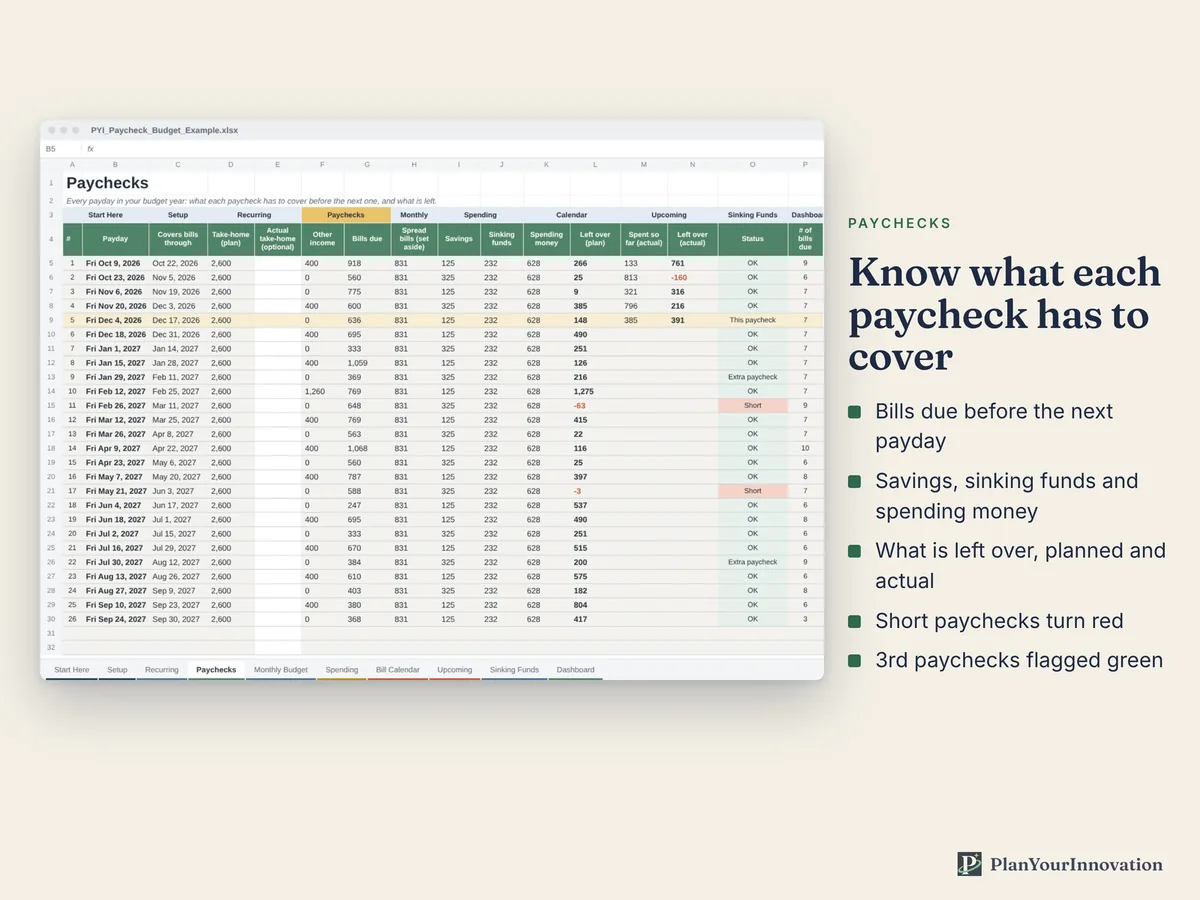
Here's the Paychecks tab in the filled-in example file that comes with it, with short paychecks in red and third paychecks flagged:
The Paychecks tab in the Paycheck Budget Spreadsheet's example file.
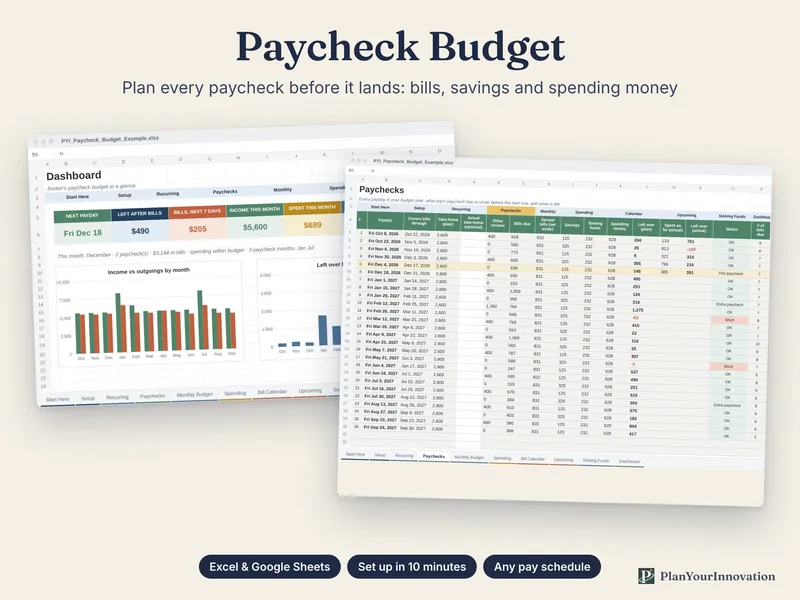
It also has a Bill Calendar with each payday and bill on its date, an Upcoming list of the next 40 items, a 1,000-row spending log that knows which paycheck covers each purchase, and a dashboard with six charts. The numbered Setup tab gets you started in about 10 minutes, in light or dark.
Templates that help
The Paycheck Budget Spreadsheet is the fastest way to use this guide: list your paydays and bills once, and every paycheck's plan is worked out for you, in Excel and Google Sheets.
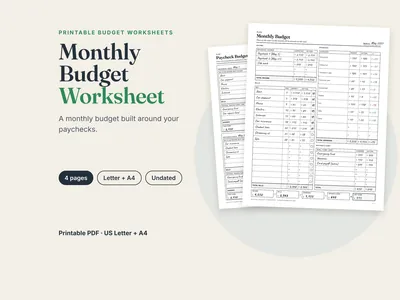
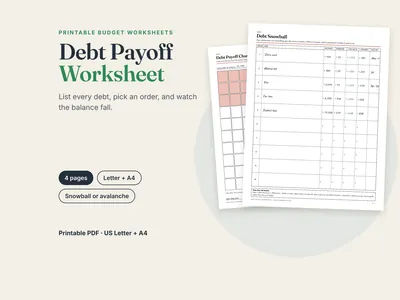
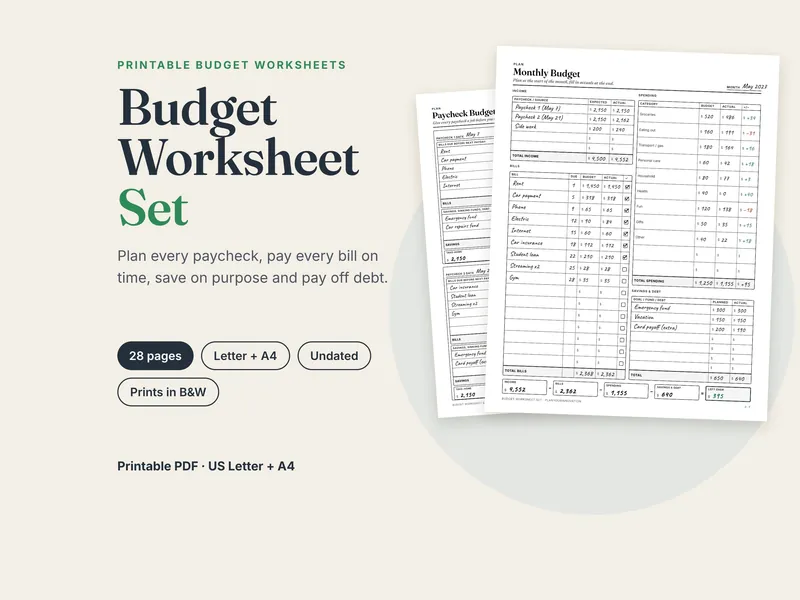
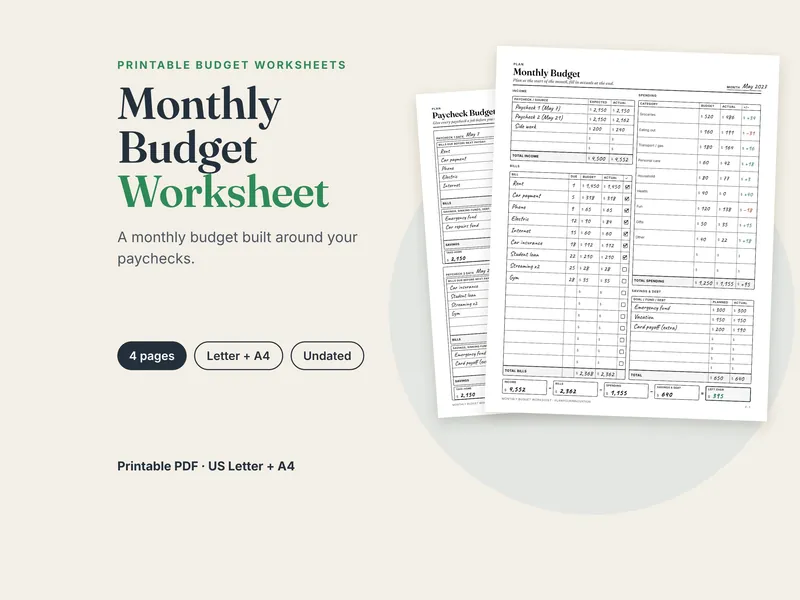
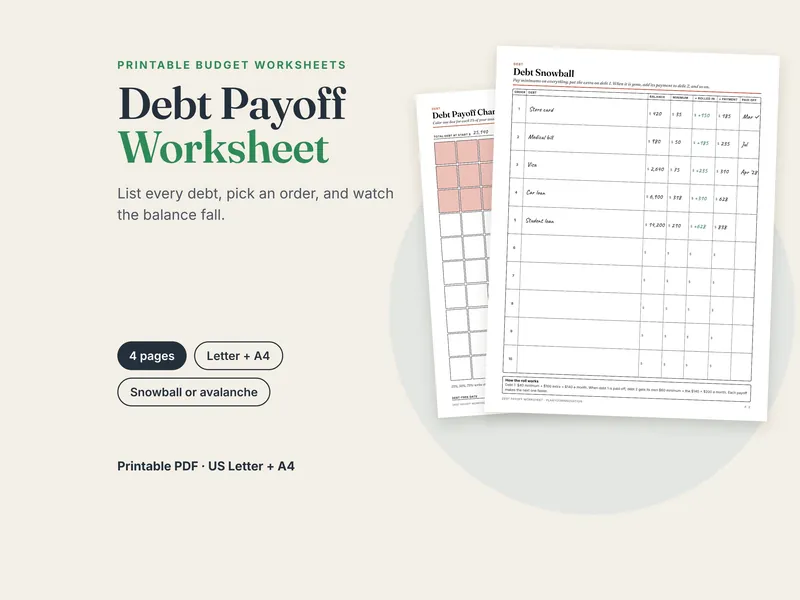
Prefer paper? The Budget Worksheet Set has 28 printable pages in Letter and A4, including the Paycheck Budget page from this guide, a Paycheck Schedule, a bill tracker and calendar, sinking funds and a debt snowball. For a single month, the Monthly Budget Worksheet has a paycheck-based budget, a bill checklist and an expense log on four pages.
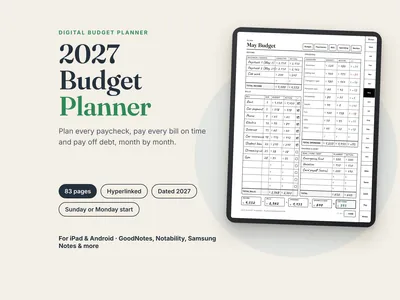
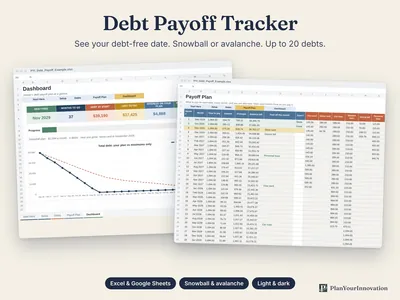
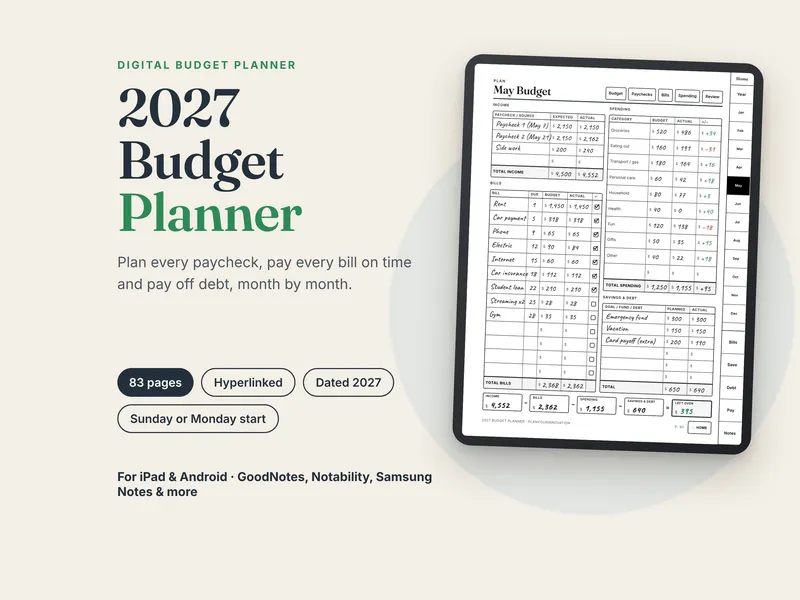
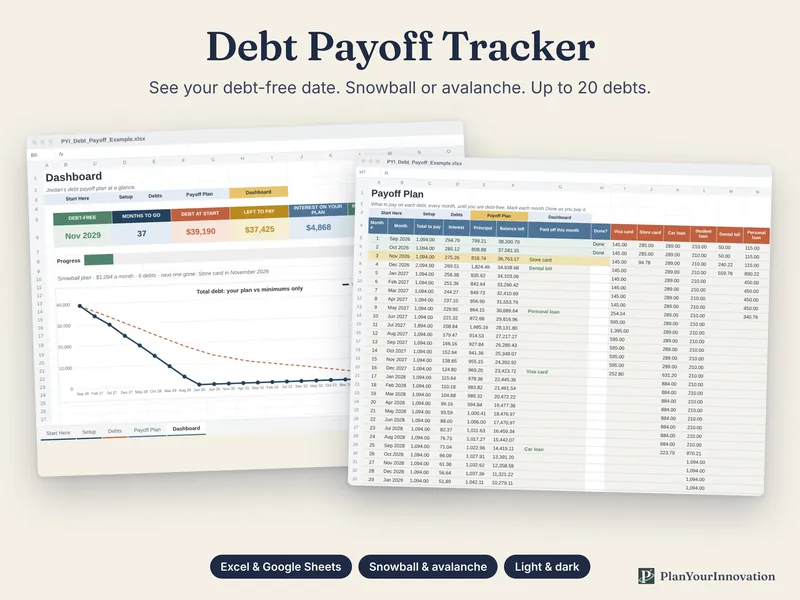
Paying off debt? The Debt Payoff Tracker Spreadsheet handles up to 20 debts, snowball or avalanche, and shows your payoff date and the interest you save. If you plan on an iPad or Android tablet, the 2027 Digital Budget Planner has a tab for every month with a paycheck plan, budget, bills, spending log and savings.
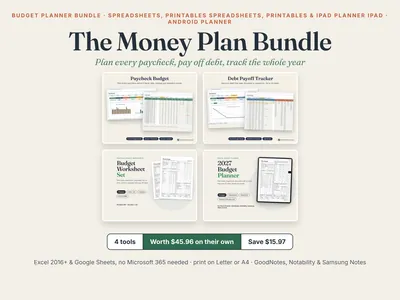
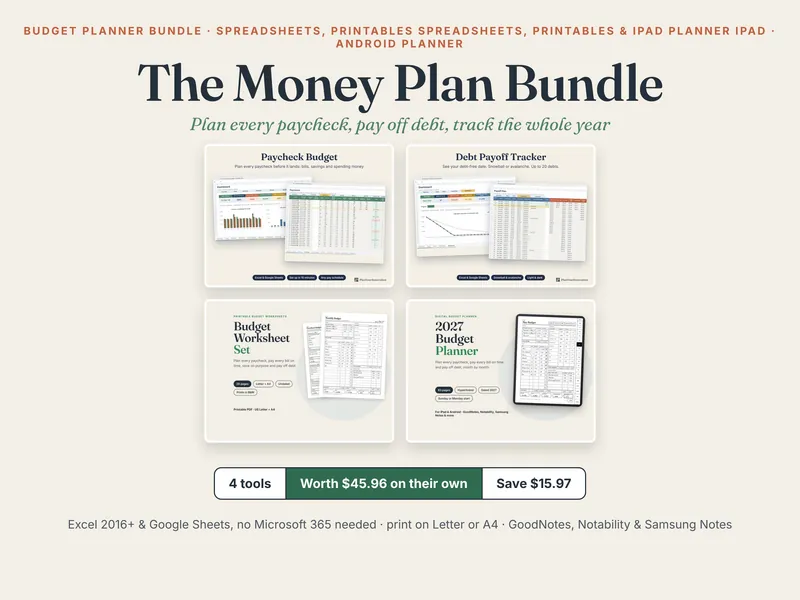
Want the whole set? The Money Plan Bundle has the Paycheck Budget, the Debt Payoff Tracker, the Budget Worksheet Set and the 2027 Digital Budget Planner in one download.
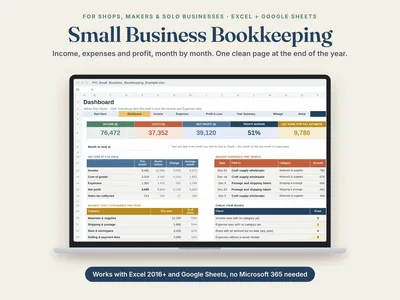
Earn from a side business too? The Small Business Bookkeeping spreadsheet logs what comes in and goes out, and fills in your profit and loss, a mileage log and a one-page year summary for your tax preparer, so business money stays out of your paycheck plan.
Free printable pages
Plan your week as carefully as your paycheck
Get The Priority Pages free: seven printable pages to plan the week that matters and see where your work hours really go.
List every payday with your take-home pay, list every bill with its due date, and give each bill to the last paycheck before it's due. Then set an amount per paycheck for savings and yearly bills. What's left is your spending money until the next payday.
How do I budget if I get paid every two weeks?
Plan your bills on two paychecks a month and treat the two months with a third paycheck as extra. The paydays move through the month, so check which paycheck covers rent each month, and divide yearly bills by 26.
What is a paycheck budget?
A budget planned one paycheck at a time instead of one month at a time. Each paycheck gets the bills due before the next payday, an amount for savings and sinking funds, and the spending money that's left.
What should I do with a third paycheck?
Give it a job before it arrives: the emergency fund, extra on the highest-rate debt or next year's yearly bills. Your regular bills should already be covered by your other paychecks.
Is a paycheck budget better than a monthly budget?
If you're paid more than once a month, it's more accurate, because it shows whether each paycheck can cover the bills due before the next one. Many people keep both: a plan for each payday and a monthly view for the totals.

 By