Most managers wait too long to give feedback, then say too little. The missed deadline gets a sigh instead of a conversation, the problem repeats, and by review time it has turned into a label like "not reliable" that the person has never heard before. Constructive feedback fixes that while it's still small: one specific moment, what it changed, and what you need instead. This guide gives you a simple method, 30 examples of vague and clear feedback, 8 word-for-word scripts for common situations, and what to do when someone pushes back, with the Tough Conversation Planner from our Manager's Performance Review Kit.
Constructive feedback is specific, private information about something a person did, why it mattered and what you'd like to see next time. It's built to help them improve, not to record a fault. The same moment can be described in a way that helps or a way that stings: "You're always late" is a label. "You joined Tuesday's planning call 20 minutes late, so we re-planned without your numbers" is feedback.
It isn't only for problems. Specific positive feedback ("Your summary on Monday saved the client call") is constructive too, because it tells someone exactly what to keep doing. Most people hear far less of it than they think.
Why most feedback doesn't change anything
Three things go wrong again and again, and none of them is about being too soft or too harsh.
It's too late. By the time it's said, the moment is weeks old and nobody remembers the details, so the conversation becomes an argument about what happened.
It's a label, not an example. "Be more proactive" can't be acted on. The person agrees, nods, and changes nothing because they don't know what to do differently on Monday.
There's no next step. Feedback without an agreed change and a check-in date is just a comment. A week later, both of you have forgotten it.
SBI stands for Situation, Behavior, Impact. It's the simplest way to keep feedback about facts, not personality. Add two steps at the end and the conversation leads somewhere:
Situation: one specific time and place. "In Tuesday's planning meeting..."
Behavior: what they did or said, as a camera would see it. No labels like careless, negative or lazy. "...you arrived 20 minutes late and the update wasn't sent."
Impact: what it changed, and for whom. "The team waited, and Jo re-planned the week without your numbers."
Ask: "What's your view?" Then listen. There's often a reason you didn't know about.
Agree the change: what good looks like, by when, and the support you'll give. "On time, with the update sent by Monday 5pm, starting next week. I'll move our 1:1 off Monday afternoon."
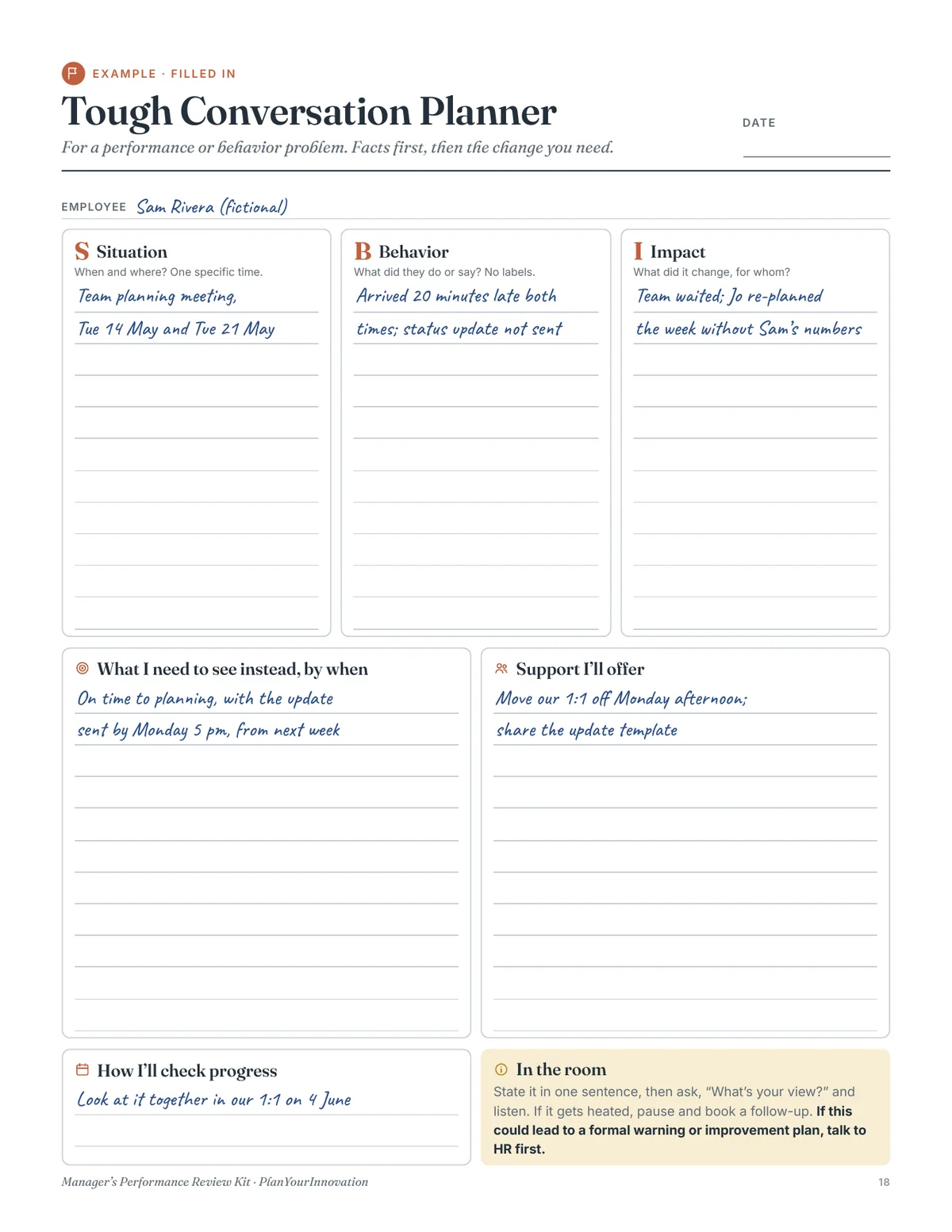
Writing it down first takes five minutes and stops you from softening the message until it disappears. Here's the Tough Conversation Planner filled in for exactly this situation, with the follow-up date already set:
The Tough Conversation Planner from our Manager's Performance Review Kit, filled in for one situation.
Constructive feedback examples: 30 vague vs clear
Each vague line below is something managers really say. The clear version names the moment, the effect and the next step. Use them as patterns, then swap in your own facts.
Quality of work
Vague: "Your work is sloppy." Clear: "The March report had three wrong totals, and finance caught them after it went out. Can you add a second check before you send numbers?"
Vague: "Pay more attention to detail." Clear: "Two of the five client emails this week went out with the wrong name. Let's use the template with the merge field from now on."
Vague: "This isn't good enough." Clear: "The draft covers the what but not the why. Before Thursday, add two lines on the business reason for each change."
Vague: "You rush things." Clear: "The release notes went out before QA signed off, and we had to send a correction. Wait for the sign-off, even if it means sending a day later."
Vague: "Great work on the report." Clear: "Putting the summary at the top of the report meant the director read it in the meeting. Keep doing that."
Deadlines and reliability
Vague: "You're always late with things." Clear: "Two of the last six deadlines slipped by three to five days. What's getting in the way?"
Vague: "I need you to be more reliable." Clear: "When a date is going to move, tell me two days before, not on the day. Then I can warn the client."
Vague: "Manage your time better." Clear: "You said yes to three requests last week on top of the audit. Let's agree that new requests come through me until the audit is done."
Vague: "You need to follow through." Clear: "You promised the vendor a reply on Friday, and they chased me on Tuesday. Can you put promises like that in your task list with a date?"
Vague: "Thanks for always being dependable." Clear: "You've hit every payroll deadline this year, including the week you were covering for Ana. That's why I gave you the new process."
Communication
Vague: "You need to communicate better." Clear: "I found out about the delay from the client. Send me a short status note every Friday, even when nothing's wrong."
Vague: "Your emails are too long." Clear: "The ask in your email to IT was in paragraph four, and they missed it. Put the request in the first line."
Vague: "Speak up more." Clear: "You had the best idea about the onboarding fix, and you told me after the meeting. Can you bring it to Thursday's team meeting?"
Vague: "Don't be so blunt." Clear: "In the design review you said Leo's draft was useless. Say what isn't working and why, so Leo can fix it."
Vague: "Good presentation." Clear: "Starting with the customer complaint got the room's attention, and the leadership team asked for your slides. Use that opening again."
Teamwork and behavior
Vague: "You're not a team player." Clear: "You missed three of the five handover meetings this quarter, so the night team started without your notes. I need you at all of them from next week."
Vague: "You have a bad attitude." Clear: "You interrupted Priya three times in Monday's meeting, and she stopped contributing. Let people finish before you come in."
Vague: "Be more collaborative." Clear: "You rebuilt the pricing sheet without asking finance, and they now have two versions. Next time, check with Dana before you change a shared file."
Vague: "Be nicer to people." Clear: "When Sam asked a question in the team chat, the reply was just to read the doc. Point to the right section; it takes the same time."
Vague: "Thanks for helping out." Clear: "You trained both new hires, and they were working on their own by week three. That saved me a month."
Ownership and initiative
Vague: "Be more proactive." Clear: "You saw the stock warning on Monday and waited for me to ask on Wednesday. When you spot a risk like that, flag it the same day."
Vague: "Take more ownership." Clear: "The vendor issue bounced between three people for a week. You're the owner now: decide, and tell me what you decided."
Vague: "Think more strategically." Clear: "Bring me a six-month plan for the help center by March 15: what to fix first and why."
Vague: "You need to step up." Clear: "I'd like you to run the Monday stand-up from February. I'll do the first one with you."
Vague: "Great initiative." Clear: "You flagged the billing bug before month end, and the fix shipped in time. That's exactly the kind of early warning I want."
Growth and confidence
Vague: "You lack confidence." Clear: "Present your own project at the March team meeting. We'll do a 15-minute run-through the day before."
Vague: "You're not ready for promotion." Clear: "You'll be ready once you've led one project end to end. Let's pick one this quarter."
Vague: "Work on your leadership." Clear: "When the team disagreed about the launch date, you went quiet. Next time, summarize both views and propose a decision."
Vague: "Learn more about the business." Clear: "Sit in on two sales calls this month, then tell me one thing that would change how we write proposals."
Vague: "You're doing great, keep it up." Clear: "Your customer score is 94% against a team average of 89%. Let's talk about you coaching one person on calls."
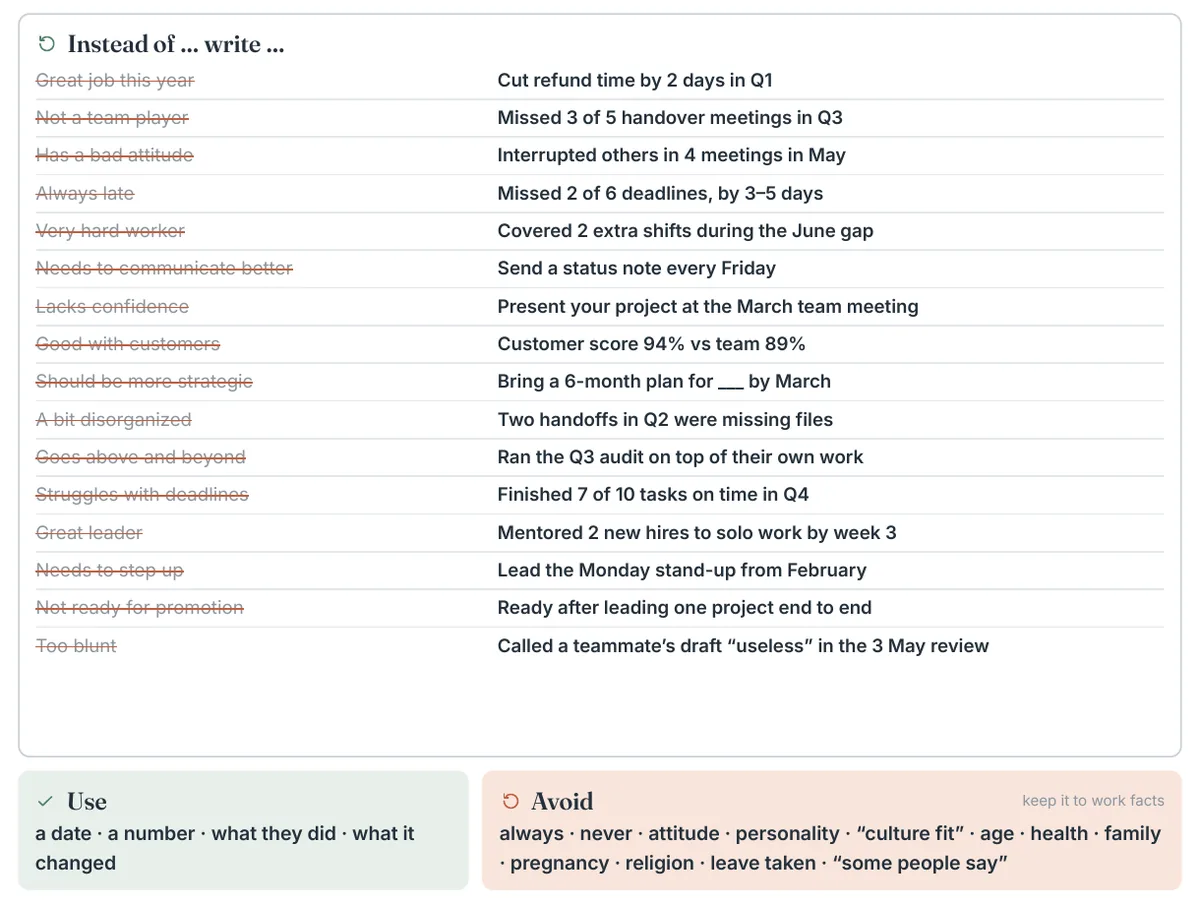
The same "instead of... write..." idea is built into the Phrase Bank in our Manager's Performance Review Kit, with a list of words to keep out of feedback altogether:
Sixteen "instead of... write..." swaps from the Phrase Bank in our Manager's Performance Review Kit.
Constructive feedback scripts for 8 common situations
Say it in one or two sentences, then ask a question and stop talking.
A missed deadline: "The proposal was due Friday and came in Tuesday, so I had to ask the client for more time. What happened, and what would help next time?"
Late to meetings: "You've joined the last three team meetings 10 to 20 minutes late, and we've had to repeat the first item. Is something clashing with that slot?"
Mistakes in work: "The last two invoices had the wrong tax rate, and the customer noticed. Let's walk through the check you do before sending."
Interrupting in meetings: "In today's meeting you cut in on Priya twice before she'd finished. I want everyone's ideas heard. Can you hold your point until she's done?"
Missing in team chat: "Three questions from the night team went unanswered yesterday, and one held up an order. Can we agree a response time during your shift?"
Over-promising to customers: "You told the client we'd deliver by the 10th without checking with ops, and we can't. Before you give a date, check it with Dana."
Quiet in meetings: "You know this account better than anyone, and you didn't speak in the planning meeting. I'd like your view in the room next time. What would make that easier?"
Strong work that deserves more: "The way you handled the outage call calmed the customer and saved the renewal. I'd like you to write it up as a guide for the team."
How do you give positive feedback that sticks?
Use the same method as for a problem: the moment, what they did and what it changed. "Great job" feels nice for a minute. "Your Monday summary meant the director could answer the client in the meeting" tells someone exactly what to repeat, and shows you noticed the detail.
Give it soon, give it in a sentence, and give it more often than you think you need to. Many managers aim for several pieces of positive feedback for every correction. You don't need a ratio, but if the only time someone hears from you is when something's wrong, they'll start dreading your 1:1s.
How to deliver feedback in a one-on-one
Do it soon. Within a day or two, while you both remember the details. Don't save it for the review.
Do it in private. Praise can be public. Corrections almost never should be.
Write it down first. Three lines: situation, behavior, impact. It keeps you calm and stops you from talking around it.
Say it in one sentence, then ask. "What's your view?" Listen to the whole answer before you reply.
Agree one change and a date. Write it in your 1:1 notes so you both see it next week.
Follow up. If it improved, say so. That's feedback too, and it's the part most managers forget.
What if they push back or get upset?
Pushback usually means one of three things: they disagree with the facts, they have a reason you didn't know, or the timing is bad. Stay with the facts ("On Tuesday and the Tuesday before"), ask for their side and be willing to change your mind if they show you something new. If they get upset, pause: "Let's take a break and pick this up tomorrow." A calm follow-up beats a heated finish.
If the same issue keeps coming back after clear feedback, or it could lead to a formal warning or a performance improvement plan, talk to HR before the next conversation. Our performance improvement plan examples show what a fair written plan looks like. This guide isn't HR or legal advice.
How do you give feedback to your manager or a peer?
The method is the same; the framing changes. With a peer, make it about the shared goal: "When the specs come in on the day of the build, my team works late to catch up. Could we aim for two days before?" With your manager, ask first and make it easy to say yes: "Can I give you some feedback on the planning meeting? When the agenda comes out the night before, we have nothing ready. Could it go out two days earlier?"
Keep it to one point, offer a fix, and choose a calm moment, ideally your 1:1. For more peer and upward examples, see our 360 feedback examples.
Common feedback mistakes
The feedback sandwich. Praise, criticism, praise. People learn to wait for the middle, and the praise starts to sound fake. Give positive and constructive feedback separately.
Labels instead of behavior. "Lazy", "negative" or "not a culture fit" start an argument. A date and an action don't.
Saving it for the review. Nothing in a review should be a surprise. If it is, the feedback came too late.
Talking about personal life. Keep feedback to work facts. Never refer to age, health, family, pregnancy, religion or leave taken.
"Some people have said..." Anonymous complaints can't be checked or answered. Speak to what you saw, or ask the person to raise it directly.
No follow-up. If you never mention it again, the message is that it didn't matter.
What problems does the Manager's Performance Review Kit solve?
The Manager's Performance Review Kit is built so that feedback happens all year and the review is never a surprise. Here's what it fixes:
The problem: by the time you give feedback, you've forgotten the details. How it helps: the Evidence Log captures the date, what happened, the impact and the source in two minutes after a 1:1, good work and misses alike.
The problem: hard conversations get softened until they say nothing. How it helps: the Tough Conversation Planner walks you through situation, behavior, impact, what you need instead by when, the support you'll offer and how you'll check progress.
The problem: your wording comes out as labels. How it helps: the Phrase Bank has lines for each rating level and 16 "instead of... write..." swaps, plus a list of words to keep out of feedback.
The problem: feedback is given once and forgotten. How it helps: the Development Plan and 30-60-90 Day Check-ins turn each piece of feedback into goals they own, with dates you'll both see again.
Templates that help
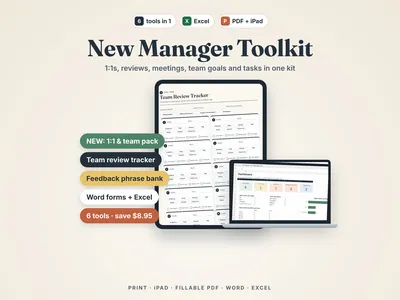
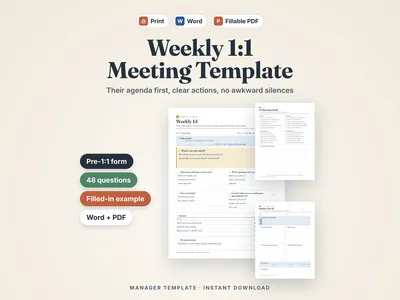
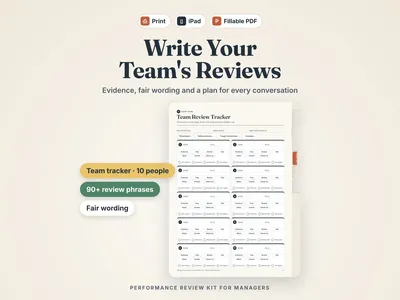
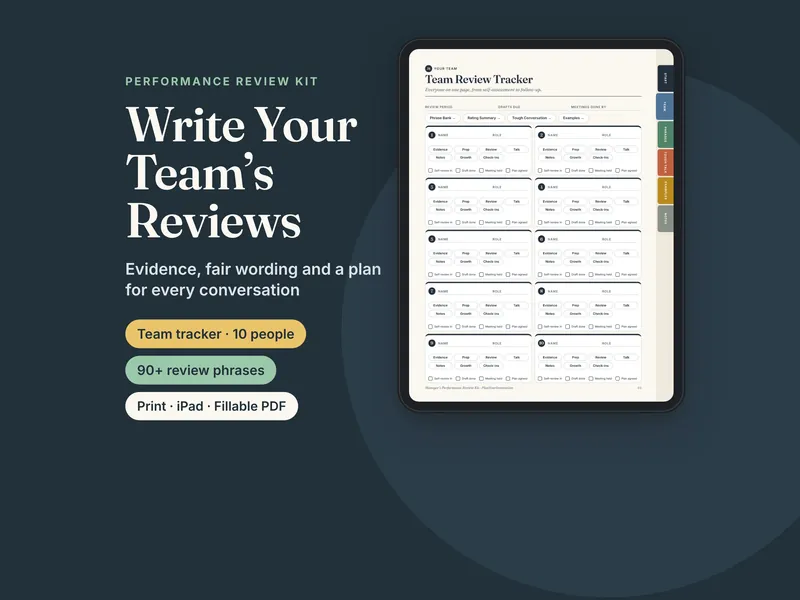
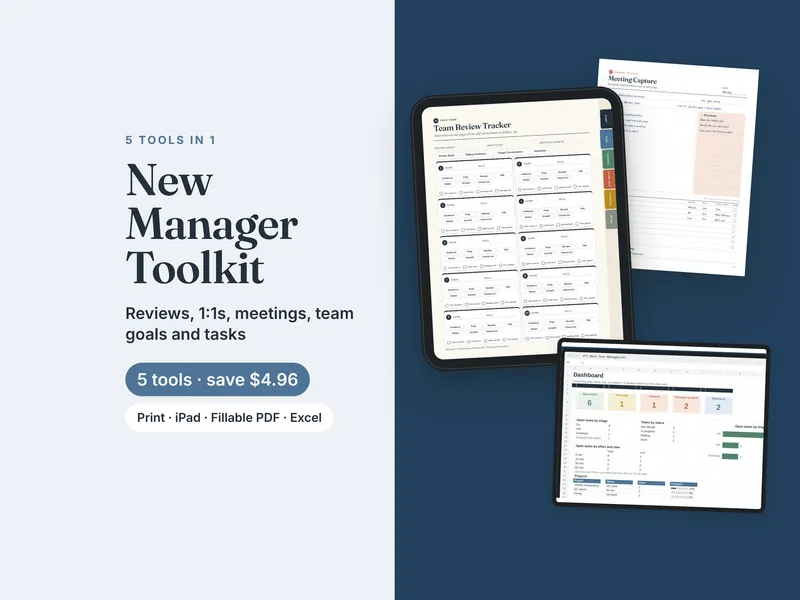
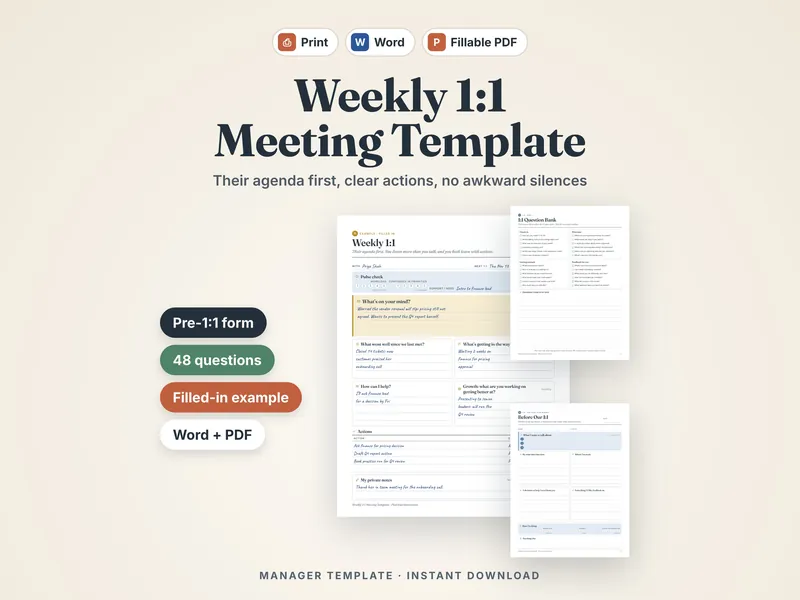
The Manager's Performance Review Kit covers feedback from the first note to the year-end review: an Evidence Log, Review Prep, a Review Writing Worksheet, a Phrase Bank, a Rating Summary, Conversation and Tough Conversation Planners, a Development Plan and check-ins, with filled-in examples. New to managing? The New Manager Toolkit includes the whole kit plus Weekly 1:1 pages, a 48-question 1:1 bank, a Delegation Planner and a Team Working Agreement. If you just want somewhere to give feedback every week, start with the Weekly 1:1 Meeting Template. See our one-on-one meeting questions for the conversation around it, and the new manager toolkit page for everything inside.
Start free
Put your feedback into a fair, clear review
Get a free one-page performance review form: results against goals, strengths, areas to grow, a rating with clear levels and a 90-day plan. Fillable, Letter and A4.
Free. Plus a short work-planning tip about once a week. Unsubscribe anytime.
"In Tuesday's planning meeting you arrived 20 minutes late and the update wasn't sent, so Jo re-planned the week without your numbers. Can you be on time, with the update sent by Monday 5pm, from next week?" It names one moment, the effect and the change you need.
What is the SBI feedback method?
Situation, Behavior, Impact: say when and where it happened, what the person did (no labels) and what it changed. Then ask for their view and agree a next step.
How often should managers give feedback?
Little and often. A sentence of specific feedback in each weekly 1:1, positive or constructive, works better than a long conversation once a quarter. Nothing in the annual review should be a surprise.
Should you use the feedback sandwich?
Usually not. People learn to wait for the criticism in the middle, and the praise starts to sound insincere. Give positive feedback on its own, and constructive feedback clearly and kindly.
How do you give constructive feedback to your boss?
Ask first ("Can I give you some feedback on...?"), keep it to one specific example and its effect on your work, and offer a fix. A 1:1 is the best place for it.

 By